

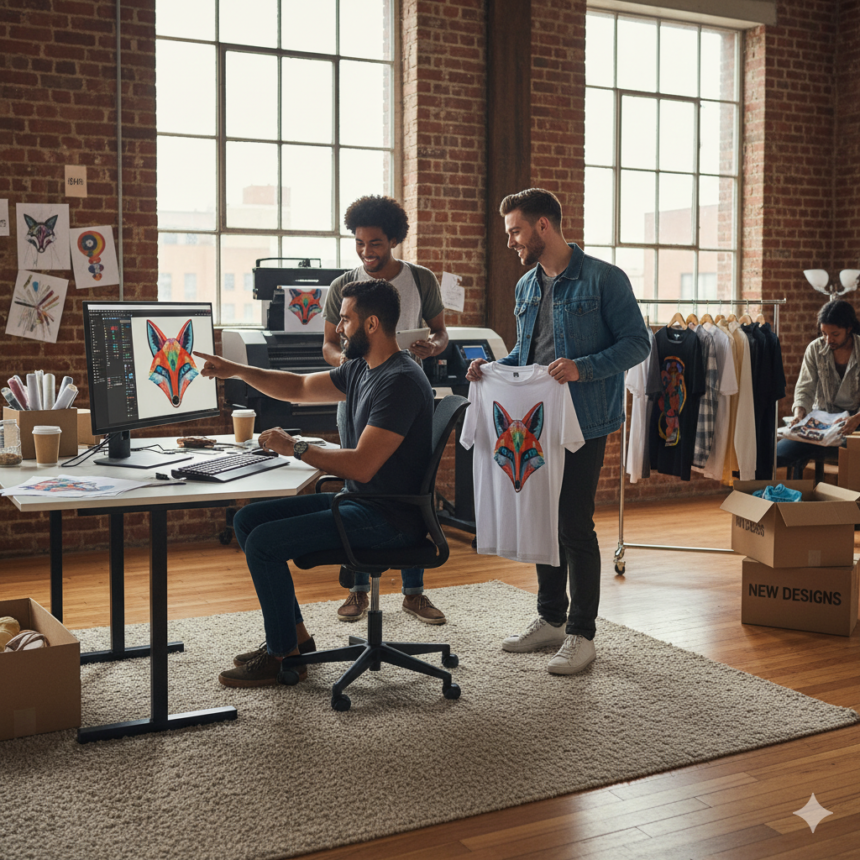
Roadmap — starting a trendy T-shirt printing business (step-by-step, from my experience)
Source quality blank tees → decide production model (in-house vs outsource) → set up design, branding & pricing → build online + offline sales channels → run fulfillment, customer service, & growth loops → scale.
- Key printing technologies (decide which one)
- Actions — buying & setting up (weeks 1–6 after decision)
- Advantages & immediate wins
- Risks & mitigations
- Actions — vendor selection & integration (week 1–4)
- Advantages
- Risks & mitigations
- Website & online storefront
- Marketplaces & social
- Offline channels
- Marketplaces & Platforms to Sell Your T-Shirts
- 1. Amazon India
- 2. Flipkart Seller Hub
- 3. Meesho Supplier
- 4. Ajio Seller (AJIO Business / Reliance)
- 5. Myntra Seller (via Myntra Partner Portal)
- 6. Snapdeal Seller
- 7. TataCliq Seller (Tata UniStore)
- 8. IndiaMart
- 9. Craftsvilla
- 10. JioMart Seller
- If you have in-house printing
- If you outsource printing
- Delivery & couriers
- Packaging & unboxing
- 1) New order SOP (in-house)
- 2) Vendor order SOP (outsourced)
- 1️⃣ Step 1 — Understand the Current Market Landscape
- 2️⃣ Step 2 — Define Your Niche (Examples & Differentiation Angles)
- 3️⃣ Step 3 — Decide Fabric Quality (GSM & Use Case)
- 4️⃣ Step 4 — Differentiate Beyond Design
- A. Fabric Differentiation
- B. Fit Differentiation
- C. Design Differentiation
- D. Packaging Differentiation
- E. Speed & Service Differentiation
- 5️⃣ Step 5 — Build Emotional Positioning
- 6️⃣ Step 6 — Product Line Strategy (Build Tiered Offerings)
- 7️⃣ Step 7 — Build Brand Identity Around Your Niche
- 8️⃣ Step 8 — Test and Validate Your Niche
- 9️⃣ Step 9 — Build “Why You” Story (Real Differentiation)
- 10️⃣ Step 10 — Long-Term Differentiation Strategy (Future Goals)
- ✅ Summary Table: Differentiation Levers
- 💬 Pro Real-Life Founder Insight:
- 1️⃣ Step 1 — Understand What “Trend” Means in T-Shirt Business
- 2️⃣ Step 2 — Core Sources to Find Design Trends
- 3️⃣ Step 3 — Analyze & Predict What Will Sell
- 4️⃣ Step 4 — Where & How to Create Designs (Legally + Fast)
- Option A: Design It Yourself (DIY)
- Option B: Outsource to Freelancers or Artists
- Option C: Buy Ready-to-Use Licensed Designs
- Option D: Use AI Tools (Modern, Fast, Customizable)
- 5️⃣ Step 5 — Design File Preparation for Printing
- 6️⃣ Step 6 — Trend Validation Before Bulk Printing
- 7️⃣ Step 7 — Create a “Trend Cycle Calendar”
- 8️⃣ Step 8 — Trend Adaptation by Niche
- 9️⃣ Step 9 — Design Naming & Drop Strategy
- 🔟 Step 10 — Long-Term Trend System (Build a Design Pipeline)
- ✅ Pro-Tips from Real Brand Experience
- 🎯 Summary: Trend → Design → Print → Launch Loop
- Bonus: Tools & Resources List
- 🎯 Goal:
- 1️⃣ Step 1 — Learn the Basic Parts of a T-Shirt
- 2️⃣ Step 2 — Know the Types of Fabric Used for T-Shirts
- 3️⃣ Step 3 — Understand GSM (Grams per Square Meter)
- 4️⃣ Step 4 — Where to Buy T-Shirt Raw Materials (Offline & Online)
- 🏬 Offline Options (Highly Recommended for Beginners)
- 💻 Online B2B Options (For comparison & later scaling):
- 5️⃣ Step 5 — How to Identify Quality Fabric (Even with Zero Experience)
- 6️⃣ Step 6 — Stitched Blank T-Shirts vs Buying Fabric Rolls
- 7️⃣ Step 7 — Key Specifications You Must Ask Suppliers
- 8️⃣ Step 8 — Quality Control (QC) Before & After Printing
- 9️⃣ Step 9 — Packaging Materials (Final Raw Items)
- 🔟 Step 10 — Supplier Relationship & Price Negotiation Tips
- 🧩 Example of Real-Life Cost Calculation (Per T-Shirt, 180 GSM)
- ⚙️ Step-by-Step Summary — For Complete Beginners
- ✅ Key Documents & Registrations
- 📌 Specific Useful Links (for online applications)
- 🎯 Which ones you must start with (for your T-shirt business)
- 🎯 Goal:
- 🏠 Realistic Starting Situation
- 🔹 1️⃣ Two Inventory Models to Choose From
- 🔹 2️⃣ How to Start Inventory with Low Investment
- 🔹 3️⃣ Real-Life Lean Cost Chart (Month 1 Setup)
- 🔹 4️⃣ How to Store & Manage Inventory in Small Space
- 🔹 5️⃣ Example: Simple Google Sheet Inventory Format
- 🔹 6️⃣ How to Manage Cost Without Space or Warehouse
- 🔹 7️⃣ Monthly Cash Flow Example (Real Scenario)
- 🔹 8️⃣ Stock Reorder Strategy
- 🔹 9️⃣ Pro Tips from Real Founders
- 🔹 10️⃣ Example: Visual Cost Chart (Startup Model)
- 🧩 Summary — The Smart Startup Formula
- ✅ Website & E-commerce Setup Cost
- 📱 Mobile App Setup Cost
- 🔍 Summary & What to Choose at Each Stage
- 🎯 1. Goal
- 🔹 2. Real-Life Approach (Think Small but Smart)
- 🧩 Step-by-Step: CUSTOMER SERVICE SETUP
- Step 1: Choose Communication Channels
- Step 2: Create a Customer Query Tracker
- Step 3: Prepare Message Templates (for WhatsApp & Email)
- 👕 3. RETURNS & EXCHANGES — The Practical Guide
- Step 1: Make a Clear Return Policy
- Step 2: How to Manage Returns in Real Life (Low-cost Execution)
- Step 3: Handling Courier & Reverse Pickups
- Step 4: Inspection Checklist (Simple SOP)
- 💰 4. COST STRUCTURE (Real-Life Example)
- 🧠 5. TRAINING YOURSELF OR STAFF (If You Grow)
- ❤️ 6. Turning Support into Sales
- 📊 7. Return Minimization Tactics (to Save Money)
- ⚙️ 8. Example Real-life Flow (Small Brand Setup)
- 📦 9. Return Process Flow (Visual Summary)
- 🏁 10. Final Checklist for “Pro-level” Customer Service
- “From Printing to Selling — What Every T-shirt Brand Founder Faces (and How to Overcome It)”
- 1️⃣ Difficulty: Finding Reliable Raw Material Suppliers
- 2️⃣ Difficulty: Choosing Between Outsourcing vs Buying Printing Machine
- 3️⃣ Difficulty: Low Budget & Limited Space
- 4️⃣ Difficulty: Delivery Delays & Logistics
- 5️⃣ Difficulty: High Return Rate or Fake Returns
- 6️⃣ Difficulty: Managing Cash Flow
- 7️⃣ Difficulty: Marketing Fatigue & Low Engagement
- 8️⃣ Difficulty: Maintaining Consistent Quality
- 9️⃣ Difficulty: Legal & Compliance Confusion
- 🔟 Difficulty: Scaling Without Losing Control
- 11️⃣ Difficulty: Unhappy or Angry Customers
- 12️⃣ Difficulty: Burnout & Motivation Drop
- 1) Quick overview — what shipping/logistics covers
- 2) Step-by-step setup if you know nothing
- Step 0 — What you need physically
- Step 1 — Decide packaging standard
- Step 2 — Weigh & measure every parcel
- Step 3 — Choose courier options (start with 2)
- Step 4 — Understand pricing components
- Step 5 — Decide your customer shipping policy
- Step 6 — Printing labels & pickup
- Step 7 — Tracking & customer updates
- Step 8 — Handling COD payments & reconciliation
- Step 9 — Returns (reverse logistics) process
- Step 10 — Scale decisions (when orders grow)
- 3) Packaging — exact practical checklist & templates
- 4) Cost examples & mini-chart (real life estimates for India, per parcel)
- 5) Choosing courier & service levels (how to decide)
- 6) Integrations & automation (save time)
- 7) International shipping (if you want to export later)
- 8) Fraud, RTO, and prevention hacks
- 9) Metrics to track (KPIs)
- 10) Customer communication templates (copy-paste)
- 11) First 30-day checklist (do these exactly)
- 12) Scaling: when & how to move to 3PL / fulfillment
- 13) Final practical tips & founder hacks
- 🔍 Problem Overview:
- 🧱 Step-by-Step Breakdown
- Step 1 — Understand Market Pricing Structure
- Step 2 — Know Your True Cost (COGS)
- Step 3 — Avoid the “Cheap Price Trap”
- Step 4 — Create a “Value Ladder”
- Step 5 — Build Differentiation (so you can charge more)
- Step 6 — Study Competitors Smartly
- Step 7 — Practical Tips to Handle Pricing Pressure
- Step 8 — Summary Chart
- 🔹 Step 1 — Identify Growth Stage
- 🔹 Step 2 — Challenges in Scaling & Solutions
- 1. Space & Storage
- 2. Production Bottleneck
- 3. Order & Inventory Management
- 4. Cash Flow Crunch
- 5. Quality Consistency
- 6. Team Building
- 7. Technology & Automation
- 8. Customer Experience
- 9. Marketing Scaling
- 10. Leadership & Mindset
- 🔹 Step 3 — Scaling Cost Snapshot (Real-life Example)
- 🔹 Step 4 — Scaling Framework Summary
- ⚙️ 1️⃣ Product Quality & Raw Material Confusion
- 🏭 2️⃣ Printing & Production Issues
- 📦 3️⃣ Inventory & Space Constraints
- 💰 4️⃣ Cash Flow & Pricing Struggles
- 🌐 5️⃣ Website & Technical Challenges
- 📦 6️⃣ Shipping & Logistics Problems
- 📣 7️⃣ Marketing & Promotion Challenges
- 💬 8️⃣ Customer Service & Returns
- 🔄 9️⃣ Vendor Reliability Issues
- 💻 🔟 Scaling & Team Challenges
- 📊 11️⃣ Legal & Documentation Problems
- ⚡ 12️⃣ Mental & Motivation Challenges
- 🧾 1. PRICING PRESSURE & COMPETITION
- ⚠️ The Challenge:
- 💣 Real Problems You’ll Face:
- 🧭 Step-by-Step Solution:
- Step 1: Know Your True Cost
- Step 2: Create a Niche
- Step 3: Add Perceived Value
- Step 4: Build Loyalty
- Step 5: Focus on B2B/Bulk Orders
- ✅ Summary – Pricing Pressure Solutions Chart
- 🚀 2. SCALING CHALLENGES
- ⚠️ The Challenge:
- 🧭 Step-by-Step Scaling Plan:
- Step 1: Automate Order Management
- Step 2: Outsource Non-Core Tasks
- Step 3: Expand Online Presence
- Step 4: Build Micro-Team
- Step 5: Introduce New Products
- ✅ Summary – Scaling Challenges & Solutions Chart
- 🚀 High Growth Possibility (If Done Well)
- 💡 Key Drivers of High Growth:
- 💼 Investor Pitch Deck: Trendify Threads (Example Brand Name)
- 🧩 1. Executive Summary
- 🧠 2. Problem Statement
- 💡 3. Our Solution
- 📊 4. Market Opportunity
- 🧱 5. Business Model
- 💰 6. Revenue Projection (5 Years)
- ⚙️ 7. Use of Funds
- 💬 8. Marketing Strategy
- 🧍 9. Team
- 🏆 10. Competitive Advantage
- 📈 11. Traction (Expected)
- 📬 12. Exit or Growth Plan
- 💰 WHERE TO FIND INVESTORS (WITH APPLY LINKS)
- Overview — strategy in one line
- Month 0 (Pre-launch week)
- Month 1 — Launch & Organic Traction (Weeks 1–4)
- Month 2 — Optimize & Scale Organic (Weeks 5–8)
- Month 3 — Scale Winning Channels (Weeks 9–12)
- 1) Instagram DM Outreach (to potential buyer)
- 2) Influencer Outreach (DM / Email)
- 3) Campus Rep Pitch (DM / Poster blurb)
- 4) B2B Cold Email (bulk orders)
- 5) WhatsApp Abandoned Cart Script
- 6) Post-Purchase Review Request
- 7) Customer Support Quick Reply Templates (WhatsApp Business)
- 💬 Promotional WhatsApp & App SMS Campaigns
- 🧩 1. Welcome Message (After Signup / First Visit)
- 🎨 2. New Collection Launch
- 💫 3. Flash Sale Alert
- 💌 4. Festive Campaign (Diwali / Holi / New Year, etc.)
- 🧍 5. Personalized Offer for Repeat Customers
- 🎁 6. Referral Program Launch
- 🧾 7. Cart Abandonment Reminder
- 🧢 8. Bulk Order Promotion (B2B / College / Events)
- 🔁 9. Re-Engagement Message (For Inactive Customers)
- 🏷️ 10. Limited Edition Drop (Hype Campaign)
- A — Against Bewakoof & The Souled Store (big D2C players)
- B — Against POD platforms (Printrove, Inkmonk, Printo)
- Typical competitor path (condensed)
- Your 12-month path (actionable, month-by-month)
Phase 0 — Immediate decisions & setup (days 1–14)
These are the first things to lock in before spending money.
- Decide product mix & production model
- Product mix: men’s / women’s / kids; sizes (S–XXL); fabrics (100% cotton vs cotton blend); GSM options (light 140–160, mid 180–200, premium 220+).
- Production model: Make-to-order / small batch vs pre-printed inventory. (Recommend: start with make-to-order or small batches to reduce inventory risk.)
- Register your business & paperwork
- Choose a business name and check domain availability.
- Register as proprietorship / LLP / private company depending on scale.
- GST registration (India) and business bank account.
- Basic contracts template (vendor agreements, NDAs).
- Decide pricing strategy
- Calculate cost per shirt: blank cost + printing cost + packaging + shipping + overhead.
- Target retail margin: aim for 40–60% gross margin initially; adjust by channel.
- Basic branding
- Logo, 1–2 hero designs, brand colors, tone of voice.
- Purchase domain and set up Instagram/FB + WhatsApp Business.
- Minimum Viable Offer (MVO)
- Pick 6–12 SKUs/designs to launch. Keep SKUs minimal until process is smooth.
Phase 1 — Sourcing blanks & initial inventory (days 7–30)
Where to buy blanks and what to test.
Action steps
- Identify wholesalers / manufacturers
- Find 3 blank suppliers (local wholesale market, textile hubs, or online B2B portals).
- Order small samples: different fabrics, GSMs (140, 180, 220), colors, size set.
- Check: fabric feel, shrinkage, colorfastness, label options.
- Test & confirm quality
- Wash test (3 washes), stretch test, print test (if outsourcing, ask vendor to test).
- Choose primary GSM (e.g., 180 for general use; 220 for premium).
- Negotiate terms
- MOQ (try to get low MOQs at first — many wholesalers allow 50–100 piece trial).
- Price breaks by quantity and lead time.
- Get samples with your label (or blank if you plan to attach label later).
- Decide inventory vs on-demand
- If you plan to buy a machine and do fast fulfillment, keep a small rolling inventory (popular sizes/colors).
- If outsourcing, prefer make-to-order to avoid inventory holding.
Phase 2 — Production model A: Buy printing machine (in-house)
(If you want full control, faster iteration, and higher margins — higher upfront cost & responsibility.)
Key printing technologies (decide which one)
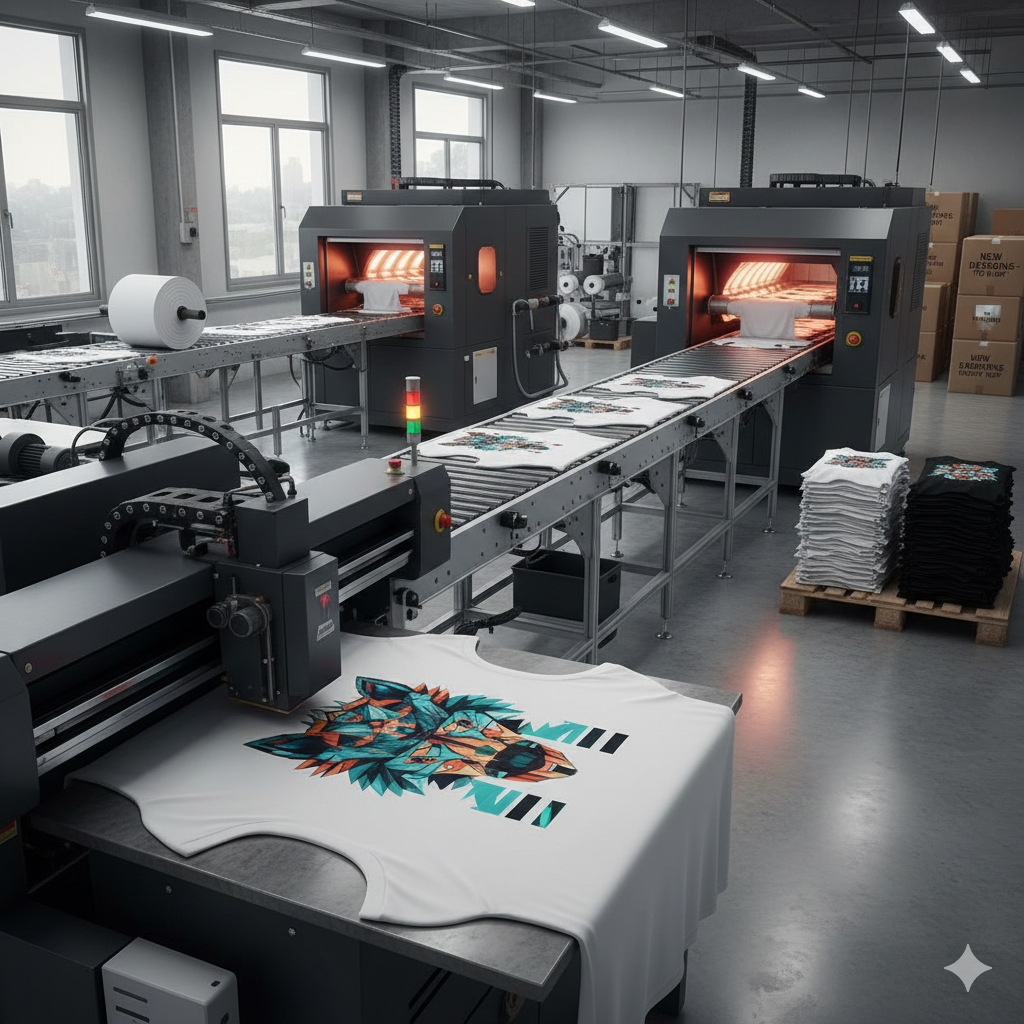
- DTG (Direct-to-Garment) — best for full-color small runs, soft handfeel. Good for made-to-order. Requires pretreatment, works best on 100% cotton.
- Screen printing — best for large runs and simple color designs; low cost per unit at scale but higher setup per design.
- Heat transfer / vinyl / sublimation — good for small runs, variable results; sublimation needs polyester.
- Hybrid (DTG + heat press) sometimes used.
(Recommendation for starting founders: DTG + heat press is easiest if you want many designs, print-on-demand, and quick turnarounds. Screen printing is better if you plan to run large batches of the same design.)
Actions — buying & setting up (weeks 1–6 after decision)
- Select machine & vendor
- Choose 2–3 machine models, compare capacity, ink costs, warranty, local service availability.
- Ask for a demo and printed sample shirts from each supplier.
- Workspace & utilities
- Space: small workshop/garage (15–30 sq. m) with ventilation and stable power.
- Power: check power draw; DTG may need 15–20A circuits and UPS for print consistency.
- Ventilation/AC (temperature affects print).
- Hire/training
- Hire 1–2 operators (initially one experienced operator + yourself).
- Arrange 1–2 days training per operator (vendor often provides).
- Create SOPs: pre-treatment, print testing, curing, quality check, packaging.
- Consumables & spare parts
- Stock inks, pretreatment solution, cleaning supplies, consumables (platens, nozzles).
- Keep spare print heads and filters if vendor recommends.
- Production workflow (SOP)
- Steps: Receive order → print file check & color proof → pretreat (if DTG) → print → cure/dry → quality check → fold & pack → dispatch.
- Build printed checklist for each step.
- Quality control metrics
- Acceptable color match tolerance, washing test pass rate, defect rate ≤ 2–3% initially.
- Capacity planning
- Estimate throughput: small DTG setups can do ~20–60 shirts/day depending on automation; screen printing can do hundreds/day per press for single-color.
- Set daily target and buffer for maintenance.
- Costs to expect (ballpark)
- Small DTG machine: significant upfront (middle range: ₹6–20 lakh; cheaper used options lower). Screen printing: lower machine cost but higher setup labor.
- Consumables: monthly ₹10k–40k depending on volume.
- Rent/space & salaries: vary by city.
Advantages & immediate wins
- Faster turnarounds and greater margin control.
- Ability to do rush orders, personalization, and frequent design tests.
Risks & mitigations
- Machine downtime: service contract + spare parts.
- Operator skill: train & document heavily.
- Cash tied up in machine: start with used or lease option if cash-tight.
Phase 3 — Production model B: Outsource printing (vendor model)
(If you want lower capital & simpler operations, focus on marketing & sales while vendors print.)
Actions — vendor selection & integration (week 1–4)
- Identify 3–6 potential vendors
- Local printers (screen & DTG), print houses that support small runs, factories that accept sample orders.
- Get samples printed on your chosen blank to compare.
- Evaluate vendors
- Criteria: print quality, color match, fabric compatibility, minimum order quantity, lead time, turnaround SLAs, pricing, references, packaging options.
- Visit vendor if possible or start with small paid sample runs.
- Negotiate contract
- Pricing per unit at different order sizes.
- SLAs: max lead time, QC rejection rate, refund/replace policy.
- Intellectual property: NDA & rights over designs.
- Minimum monthly commitment (if any).
- Logistics & integration
- Decide who ships to customer: vendor ship directly (vendor integrates with courier) or you receive & forward.
- Prefer vendor shipping directly if they can do branded packing inserts (saves time and cost).
- Build a simple order transmission workflow: email, CSV upload, or (if possible) API/Shopify integration.
- Quality control
- Maintain incoming QC checks for first 30 orders of each design.
- Keep a backup vendor for emergencies.
Advantages
- Low up-front investment; quick start.
- Focus on marketing, design, and sales.
Risks & mitigations
- Longer lead times: set customer expectations and buffer lead time publicly.
- Less control on QC: stricter sample phase & contract with penalties.
- Vendor becomes single point of failure: always have 2nd vendor.
Print-On-Demand Platforms (Sell T-Shirts Without Inventory) - 1. Printrove (India POD)
- Register:
https://printrove.com - 2. Qikink (India POD)
- Sign Up:
https://qikink.com - 3. BlinkStore
- Register:
https://blinkstore.in - 4. TeesLion
- Sign Up:
https://teeslion.com - 5. TeeSpring (Spring)
- International POD:
https://spring.com - 6. Redbubble
- Artist Registration:
https://www.redbubble.com/signup - 7. TeePublic
- Sign Up:
https://www.teepublic.com/ signup - 8. Spreadshirt
- Register:
https://www.spreadshirt.com/sell-your-designs - 9. Zazzle
- Partner Registration:
https://www.zazzle.com/sell - 10. Society6
- Register:
https://society6.com/sell
Phase 4 — Build sales channels (launch actions, day 15–60)
You’ll be selling online, offline, and via social. Here’s the step-by-step.
Website & online storefront
- Platform
- Start with Shopify / WooCommerce / Wix — quick to set up. Include product pages, size chart, FAQ, returns policy.
- Product pages
- High-quality mockups + at least 2 real photos per product.
- Size chart, fabric description (GSM), wash care, lead time.
- Checkout
- Enable multiple payments (UPI, cards, COD).
- Offer fast shipping options (paid) & free shipping threshold text.
Marketplaces & social
- Social commerce (Instagram + Facebook + WhatsApp)
- Post daily — 3 content types: product photos, behind-the-scenes (printing process), and user generated content (UGC).
- Run ‘launch’ offers: limited time discount + free shipping for first 100 customers.
- Marketplaces
- List on Amazon, Flipkart, Myntra at launch if you want wide reach. Start with 1–2 channels and expand later.
- Paid ads
- Facebook/Instagram ads focused on 3 audiences: interest (fashion), lookalike from early buyers, retargeting visitors.
- Start small: ₹300–800/day, measure CAC.
Offline channels
- Local popups & bazaars
- Rent a stall at local markets or coworking demo day.
- Use print-ready samples and live printing demo (if you have in-house print).
- Wholesale / corporate
- Cold outreach to small companies for bulk orders (office tees, events).
- Retail partnerships
- Approach boutique stores for consignment or bulk resale.
Marketplaces & Platforms to Sell Your T-Shirts
| Platform / Marketplace | What it is / Strength | How it works / What you need to register |
|---|---|---|
| Meesho | Social-commerce / reseller / marketplace — good for budget / value-conscious buyers | You can register as a “seller/supplier”, upload catalog, and Meesho handles logistics & deliveries. Only basic KYC (bank + GST). (Meesho Supplier) |
| Amazon India | Huge market reach, trusted by customers, Prime & FBA options available | Register via Amazon Seller Central; list products; you can use their fulfillment (FBA) or ship yourself. (e-tailize) |
| Flipkart | Strong presence in India’s ecommerce, wide audience including Tier-2/3 cities | Register as seller on Flipkart Seller Hub, list your T-shirts; benefit from their logistics and customer reach. (SellerSetu) |
| Myntra (and fashion-focused marketplaces) | Fashion-oriented marketplace with buyers looking specifically for clothes/apparel | If your brand looks good, you can apply to list (business registration may be required). (IncBusiness) |
| Snapdeal / Other value-marketplaces (ShopClues, etc.) | Budget-segment & pan-India reach — sells to price-conscious customers | Register as seller, list T-shirts; good if you want to push lower-cost / value tees. (Logic ERP Solutions Pvt Ltd) |
| IndiaMART / TradeIndia (B2B portals) | B2B marketplaces — for bulk / wholesale orders, corporate orders, merch for events | Create business profile, list bulk T-shirt offerings; useful for large orders (colleges/events/businesses). (Wikipedia) |
Indian 3rd-Party Marketplaces (Sell Your T-Shirts)
1. Amazon India
- Seller Registration:
https://sellercentral.amazon.in - Main Site:
https://www.amazon.in
2. Flipkart Seller Hub
- Register:
https://seller.flipkart.com - Main Site:
https://www.flipkart.com
3. Meesho Supplier
- Register:
https://supplier.meesho.com - Main Site:
https://www.meesho.com
4. Ajio Seller (AJIO Business / Reliance)
- Register (AJIO B2B):
https://www.ajibusiness.com - Main Site:
https://www.ajio.com
5. Myntra Seller (via Myntra Partner Portal)
- Register (works via email onboarding):
https://partnerportal.myntra.com - Main Site:
https://www.myntra.com
6. Snapdeal Seller
- Register:
https://sellers.snapdeal.com - Main Site:
https://www.snapdeal.com
7. TataCliq Seller (Tata UniStore)
- Apply:
https://seller.tatacliq.com - Main Site:
https://www.tatacliq.com
8. IndiaMart
- Register:
https://seller.indiamart.com - Main Site:
https://www.indiamart.com
9. Craftsvilla
- Seller Registration:
https://www.craftsvilla.com/merchant/signup - Main Site:
https://www.craftsvilla.com
10. JioMart Seller
- Register:
https://www.jiomartsellers.com - Main Site:
https://www.jiomart.com
Phase 5 — Fulfillment & customer experience
This is where in-house vs outsourced differs operationally.
If you have in-house printing
- Fulfillment flow: Order → Production schedule → Print → QC → Pack → Dispatch.
- Daily routine for a small team:
- Morning: check new orders, print priority list.
- Midday: quality check & cure.
- Afternoon: pack & dispatch to courier.
- Inventory buffer: keep 1–2 days of top sizes/colors if doing pre-printed stock.
If you outsource printing
- Fulfillment flow: Order → Send order to vendor → Vendor prints & ships → You track & customer updated.
- Daily routine:
- Morning: reconcile orders with vendor (confirm new orders).
- Midday: check vendor proofs & shipping updates.
- Afternoon: customer service/returns handling.
- Keep close SLAs & daily order reconciliation to catch errors early.
Delivery & couriers
- Negotiate with 2–3 courier partners for rates and speed (e.g., local express + national logistic).
- Offer paid express shipping option (24–48 hr in metro).
- Track delivery SLA and keep customers informed.
Packaging & unboxing
- Branded packaging (sticker + thank-you card) increases perceived value.
- Insert care instructions & return label (simple returns increase trust).
Phase 6 — Customer service, returns, and reputation
- Set return policy
- Clear returns timeline (e.g., 7 days for size or defects).
- Policy for custom prints — generally non-returnable unless defective.
- Customer support
- Use WhatsApp Business + email + phone support (shared inbox like Freshdesk later).
- Collect reviews & UGC
- Automate post-delivery email asking for review.
- Incentivize UGC with discounts for tagged photos.
Phase 7 — Growth & scaling (months 3–12)
- Measure & track KPIs
- CAC (customer acquisition cost), LTV, conversion rate, average order value (AOV), return rate, fulfillment time.
- Target conversion rate: 1–3% for e-commerce initially; aim to improve.
- Optimize product mix
- Identify best-selling designs and do small batch runs to increase margin.
- Scale production
- If in-house: add another press or 2nd machine when utilization >70% during peak.
- If outsourcing: negotiate volume discounts and shorter lead times.
- Marketing channels
- Expand to influencer partnerships, affiliate marketing, collaborations.
- Run seasonal campaigns (festival collections, college season).
- Automation & tech
- Integrate store with inventory & order management, automate email flows (abandoned cart, welcome), and use basic analytics.
- Team
- Hire: operations manager, customer support, a designer/creative, and part-time marketing.
Phase 8 — Financial controls & profitability
- Unit economics
- Track gross margin per SKU and contribution margin after fixed costs.
- Pricing
- Implement tiered pricing: basic tee ₹399, premium ₹699–999, customized ₹999+ (example ranges).
- Break-even
- Build a simple P&L: revenue, COGS, marketing, salaries, rent, depreciation (for machine).
- Funding options
- Reinvest profits, small business loan, or equipment lease for machines.
Operational SOPs — short templates you can use right now
1) New order SOP (in-house)
- New order arrives → print order sheet (ID, size, design, shipping).
- Check artwork: color profile, DPI ≥ 300, canvas size correct.
- Add to print queue with priority (express vs normal).
- Pretreat (DTG) → print → cure 60–90s (per machine instructions).
- QC: check print alignment, color, ink adhesion test.
- Fold, tag, pack → label → hand to courier before cutoff.
2) Vendor order SOP (outsourced)
- Prepare CSV with order data, include design file and customer notes.
- Send to vendor by 11:00 AM daily for same-day batching.
- Vendor confirms receipt & expected ship date within 4 hours.
- Reconcile shipment AWB numbers and update customer.
Common pitfalls & how to avoid them
- Poor first impressions (bad photos or slow delivery): invest in 10 high-quality real product photos and set honest shipping times.
- Single vendor dependence: have a backup vendor and alternate blank supplier.
- Underestimating returns/fit issues: add clear size charts and a simple returns policy.
- Ignoring cash flow: don’t overbuy inventory early; use preorders to validate demand.
- Machine downtime: maintenance plan + training + spare parts.
First 90-day execution checklist (actionable, day-by-day highlight)
Day 1–7
- Decide product mix, business name, buy domain.
- Order blank samples (3 suppliers) and 6 sample prints (if outsourcing).
Day 8–14
- Finalize best blank, choose production model.
- Register business & open bank account.
- Build IG + FB and a one-page Shopify store.
Day 15–30
- If buying machine: order machine or sign lease; arrange space.
- If outsourcing: finalize vendor, sign contract, run sample batch.
- Create 6 product pages, price products, create return policy.
Day 31–45
- Soft launch to friends/family for feedback; fix size/quality issues.
- Start small paid ads and a launch promo (first 100 orders discount).
- Set up courier accounts & packaging.
Day 46–90
- Monitor KPIs weekly.
- Start influencer/UGC push.
- Decide whether to scale machine capacity or increase vendor monthly commit.
Quick decision matrix — which model fits you?
- You should buy a machine if:
- You want fast turnarounds, personalization, and high control.
- You can afford upfront CAPEX or lease and can manage operations.
- You want higher margin per unit and don’t mind operational complexity.
- You should outsource if:
- You’re cash-conscious and want to focus on marketing & design.
- You don’t want to manage machine maintenance and staff.
- You accept slightly longer lead times and lower margin but faster launch.
Final practical tips (real-world founder wisdom)
- Start lean: validate the design-market fit before big capital spending.
- Document everything from day one — SOPs save headaches.
- Use social proof — first 100 reviewers are far more valuable than a big ad spend.
- Price psychology matters: round pricing, free shipping thresholds, and bundles move AOV.
- Be obsessive about delivery timelines — fast, reliable delivery gets repeat customers.
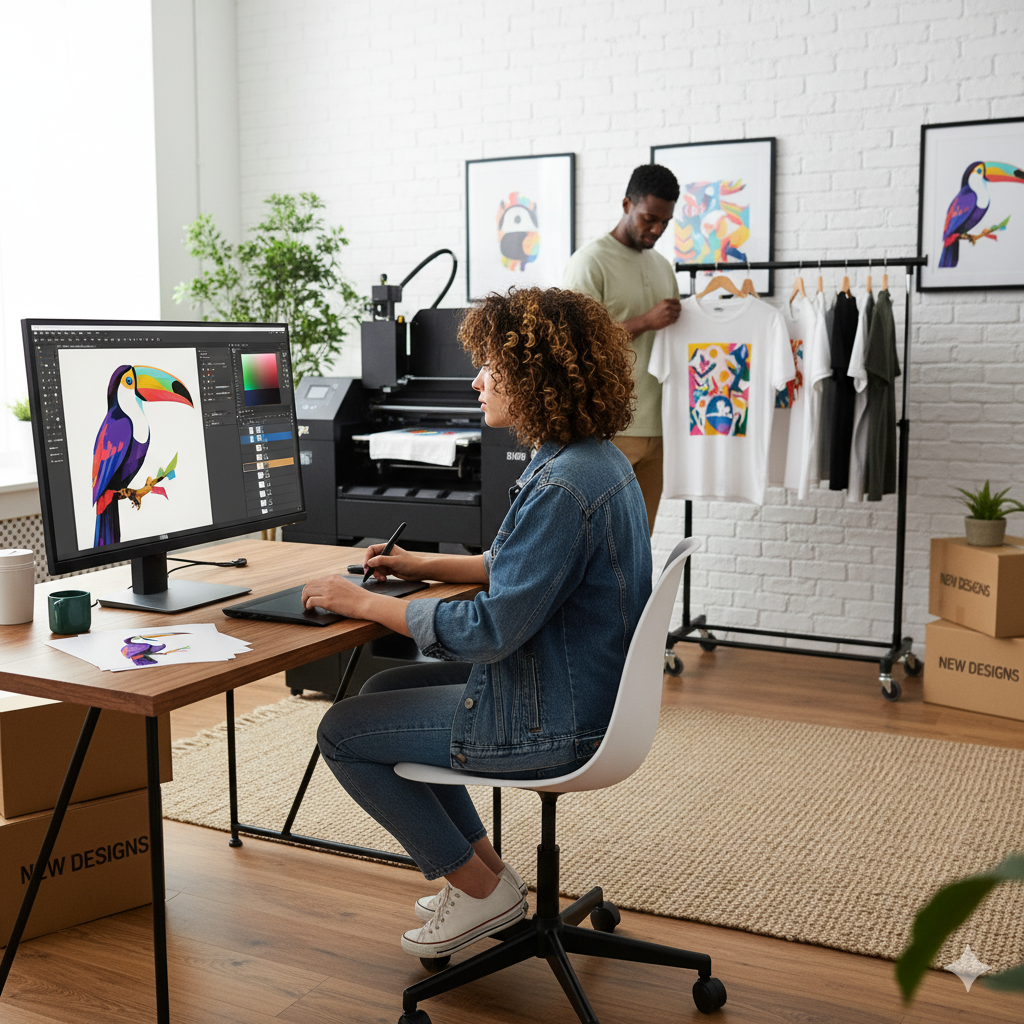
🔍 Finding Your Niche & Market Differentiation for T-Shirt Printing Business
Launching a T-shirt brand is easy — standing out is the real game.
Your niche defines who you sell to, why they choose you, and what emotional or practical value your shirts deliver beyond “just another tee.”
Below, we’ll go through how to find, test, and dominate your niche.
1️⃣ Step 1 — Understand the Current Market Landscape
Before choosing your niche, you need to know what’s already working and where gaps exist.
Current T-shirt trends in India (and globally):
- Minimalist aesthetic (clean typography, subtle logos)
- Pop-culture prints (anime, gaming, OTT quotes, meme-based)
- Streetwear & oversized fits
- Sustainable fashion (organic cotton, recycled polyester)
- Customizable prints (for birthdays, events, offices)
- Regional language or local culture tees (Hindi, Tamil, Marathi, etc.)
- College / fitness / travel themed designs
Now, you’ll pick one or two of these categories and go deep instead of wide.
2️⃣ Step 2 — Define Your Niche (Examples & Differentiation Angles)
Here are 10 niche ideas (with differentiation angle + recommended GSM & print approach):
| Niche Category | Target Audience | Design Concept | Recommended GSM | Print Method | Differentiation Idea |
|---|---|---|---|---|---|
| Streetwear Culture | 18–30 yrs, college youth, urban crowd | Bold typography, oversized, graffiti art | 200–240 GSM (heavyweight) | Screen printing / DTG | Thick premium tees + limited-edition drops |
| Fitness & Gym Wear | Gym goers, athletes | Motivational quotes, dry-fit material | 160–180 GSM (poly-cotton blend) | Heat press / sublimation | Sweat-wicking fabric + muscle-fit |
| Minimal Aesthetic Tees | Professionals, designers | Clean text, monochrome, premium finish | 180–200 GSM (cotton) | DTG / screen printing | Luxury cotton + branded minimal packaging |
| Regional Language Tees | Young audience in Tier 2–3 cities | Local slang, regional humor | 180 GSM (cotton blend) | Screen printing | Connect emotion + local language |
| Anime / Pop Culture | Teenagers, fans of anime/games | Iconic anime scenes or characters | 180 GSM cotton | DTG / sublimation | Official collabs + fan-based designs |
| Corporate / Custom Orders | Companies, teams, startups | Company logo, event themes | 160–180 GSM cotton | Screen printing | Bulk pricing + express delivery |
| Eco-Friendly / Organic Tees | Conscious youth, professionals | Nature, minimalist | 200 GSM (organic cotton) | Water-based ink / DTG | Certified organic + sustainable packaging |
| College & Fest Tees | Students, event organizers | University name, fest graphics | 160–180 GSM cotton | Screen printing | Quick turnaround + discount for bulk |
| Couple / Personalized Tees | Couples, gift buyers | Name or photo-based | 180 GSM cotton | DTG / heat press | Instant personalization via online tool |
| Travel / Adventure Tees | Travellers, bikers | Map, quote, logo | 180–200 GSM cotton | Screen printing | Partner with travel pages & groups |
3️⃣ Step 3 — Decide Fabric Quality (GSM & Use Case)
GSM (Grams per Square Meter) defines the fabric’s weight, quality, and feel. The right GSM builds your brand perception.
| GSM Range | Fabric Feel | Ideal Use Case | Pros | Cons |
|---|---|---|---|---|
| 140–160 GSM | Light, breathable | Budget tees, giveaways, summer wear | Cheap, cool for summer | Feels thin, wrinkles easily |
| 180–200 GSM | Mid-weight, premium feel | Everyday wear, online brands | Durable, ideal for printing | Slightly higher cost |
| 200–240 GSM | Heavy, thick cotton | Streetwear, oversized tees | Luxurious, long-lasting | Costly, less suitable for summer |
| 250+ GSM | Super heavy | Luxury/streetwear niche | Premium look, resale value | Expensive, not for daily wear |
✅ Pro Tip (what works best):
For most startup brands, 180–200 GSM bio-washed cotton is the sweet spot — it feels premium but affordable.
Offer one premium line (220 GSM) later for streetwear fans.
4️⃣ Step 4 — Differentiate Beyond Design
In 2025, just printing designs won’t make you stand out. The experience and positioning do.
Here’s how to build differentiation like a real brand:
A. Fabric Differentiation
- Offer Bio-Washed 100% Cotton — smooth finish, feels luxurious.
- Introduce Organic Cotton Line — certified (GOTS / OEKO-TEX).
- Try Recycled Polyester Blends for activewear.
B. Fit Differentiation
- Offer options: Regular fit, Oversized fit, Crop top for women.
- Add “Size Help Tool” or video try-ons on website.
C. Design Differentiation
- Launch limited-edition drops — only 100 pieces per design.
- Partner with local artists or college designers for unique prints.
- Allow name customization for a small extra charge.
D. Packaging Differentiation
- Use eco-friendly paper wraps, stickers, or thank-you cards.
- Add QR code for care tips or behind-the-scenes video of your print process.
E. Speed & Service Differentiation
- Offer same-day printing & shipping for express orders.
- Implement WhatsApp order updates for convenience.
- Run 7-day return/replacement to build trust.
5️⃣ Step 5 — Build Emotional Positioning
Every brand that wins emotionally connects to its tribe.
Here’s how you can position your brand depending on your niche:
| Niche | Emotional Positioning | Example Tagline |
|---|---|---|
| Streetwear | Confidence, attitude, identity | “Own Your Street.” |
| Minimal | Simplicity, class, calm | “Less Ink. More Impact.” |
| Regional | Pride, belonging | “Wear Your Culture.” |
| Eco | Responsibility, modern values | “Look Good, Feel Right.” |
| Fitness | Discipline, progress | “Train. Sweat. Repeat.” |
| Custom | Personal connection | “You Wear Your Story.” |
6️⃣ Step 6 — Product Line Strategy (Build Tiered Offerings)
Create a tiered product structure to capture different price points:
| Category | GSM | Type | Price Range (INR) | Example SKU |
|---|---|---|---|---|
| Basic Tee | 160 GSM | Cotton Blend | ₹399–499 | Daily Wear |
| Standard Premium | 180 GSM | 100% Cotton | ₹599–699 | Printed Tees |
| Heavyweight Streetwear | 220 GSM | 100% Cotton | ₹899–1199 | Oversized |
| Performance Series | 180 GSM | Poly-Cotton | ₹699–799 | Gym Tees |
| Organic Line | 200 GSM | Organic Cotton | ₹999–1299 | Eco Tees |
| Custom/Personalized | 180 GSM | DTG | ₹899+ | Custom Print |
This gives customers choice — and you capture multiple audiences under one brand.
7️⃣ Step 7 — Build Brand Identity Around Your Niche
Branding Visuals
- Logo: Simple, versatile — looks good in 1 color.
- Color Palette: Match your niche — streetwear (black/white/red), minimal (neutrals), eco (earth tones).
- Typography: Reflect attitude — bold for youth, clean for minimal.
Tone of Voice
- Streetwear → edgy, confident.
- Eco → calm, responsible.
- Fitness → motivating.
- Custom → friendly, fun.
8️⃣ Step 8 — Test and Validate Your Niche
- Pre-launch polls:
Run Instagram stories: “Which designs do you like more?” — gather votes. - Sample drops:
Print 20–30 units of 2–3 designs; test real sales at small pop-ups or via DMs. - Feedback loops:
Ask buyers for reviews on fabric feel, fit, and price fairness. - Iterate fast:
Drop new designs weekly or biweekly, keep winners, drop low sellers.
9️⃣ Step 9 — Build “Why You” Story (Real Differentiation)
Your brand story sells — not just product specs.
Example:
“We started with a single idea — to make tees that actually feel premium but don’t cost a fortune. Every shirt is 180 GSM combed cotton, bio-washed for comfort, and printed with eco-friendly inks. Whether you’re at the gym or chilling out, we want your tee to speak your vibe.”
10️⃣ Step 10 — Long-Term Differentiation Strategy (Future Goals)
| Time Horizon | Focus | Examples |
|---|---|---|
| 0–6 months | Nail one niche | Build traction in college or streetwear category |
| 6–12 months | Add product extensions | Hoodies, tote bags, caps |
| 1–2 years | Build brand community | Loyalty club, UGC campaigns, NFT drops |
| 2–3 years | Collaborate / license designs | Partner with influencers or local artists |
| 3+ years | Expand manufacturing | Export-quality tees, global dropshipping |
✅ Summary Table: Differentiation Levers
| Lever | Example for Your Brand | Impact |
|---|---|---|
| Fabric | 180–220 GSM bio-washed cotton | Premium feel |
| Fit | Oversized + regular | Trend + comfort |
| Design | Artist collabs / regional | Uniqueness |
| Speed | 24–48 hr delivery | Trust & retention |
| Packaging | Eco or branded box | Premium unboxing |
| Tech | Website personalization tool | Customer engagement |
| Pricing | ₹399–1299 tiered | Capture all segments |
💬 Pro Real-Life Founder Insight:
“In T-shirt business, your niche isn’t just a group — it’s your language. Once your audience feels like you ‘get’ them, your tees become a symbol, not a product. That’s how you scale from selling prints to building a movement.”
🎨 DESIGN & TREND CATCHING ROADMAP for T-Shirt Printing Business
1️⃣ Step 1 — Understand What “Trend” Means in T-Shirt Business
A trend is what people want to wear to express themselves right now.
It can be a meme, a movement, a color, or a cultural vibe.
👉 In the T-shirt business, trends move fast — sometimes weekly.
You must learn to:
- Catch early signals (what’s becoming popular)
- Validate popularity (ensure it’ll sell)
- Create unique artwork quickly (before competitors copy)
2️⃣ Step 2 — Core Sources to Find Design Trends
Here are the real-world, daily sources I use as a T-shirt brand owner to spot trends early:
| Source | What to Look For | How Often to Check |
|---|---|---|
| Instagram Explore & Reels | Memes, viral quotes, streetwear looks | Daily |
| Typography styles, minimalist trends | 2–3x/week | |
| TikTok / YouTube Shorts | Cultural trends, phrases, aesthetics | Daily |
| Reddit (subreddits: r/streetwear, r/fashionreps, r/graphictees, r/IndiaFashionAddicts) | What global youth are wearing | Weekly |
| Google Trends | Keyword trends like “oversized tee,” “anime shirt” | Weekly |
| TrendHunter.com | Fashion and print design concepts | Monthly |
| Etsy / Teespring / Redbubble | Top-selling print designs | Weekly |
| Amazon Best Sellers (Clothing) | Real-time top sellers | Weekly |
| Dribbble / Behance | Professional artist designs | Monthly |
| Pop culture news | Movies, series, games, events | Daily |
3️⃣ Step 3 — Analyze & Predict What Will Sell
Once you’ve gathered ideas, don’t copy — analyze them.
Ask yourself these 5 questions for each design trend you see:
- Is it emotionally relatable?
(People wear what they feel: funny, proud, motivated, rebellious) - Is it visually simple and readable?
(Text < 7 words, clear font, visible from 5 ft away) - Does it align with my niche?
(Example: Streetwear ≠ cute quotes; Eco line ≠ neon graffiti) - Can it print well on fabric?
(Avoid too many gradients if using screen printing) - Can I produce & deliver it fast?
(If it’s a temporary meme, speed matters more than perfection)
✅ Pro Tip:
Create a Google Sheet titled “Design Tracker.”
Add columns: Trend name | Source | Visual Example | Feasibility | Priority | Launch Date.
4️⃣ Step 4 — Where & How to Create Designs (Legally + Fast)
Now that you know what’s trending, here’s how to create or source your designs.
Option A: Design It Yourself (DIY)
Tools you can use:
- Canva Pro – ready templates, quick customization
- Adobe Illustrator / Photoshop – pro-grade vector artwork
- Affinity Designer – cheaper Illustrator alternative
- Photopea – free online Photoshop alternative
- Kittl (kittl.com) – built specifically for T-shirt design
- Placeit.net – also provides T-shirt mockups and templates
Process:
- Choose design concept (quote, typography, graphic).
- Set canvas: 4500 × 5400 px, 300 DPI (standard for DTG/print).
- Use transparent background (PNG).
- Export, test-print one sample on white and black tee.
✅ Tips:
- Use bold sans-serif fonts for streetwear.
- Use script/handwritten fonts for feminine or casual lines.
- Maintain consistent brand color palette.
Option B: Outsource to Freelancers or Artists
If you want unique designs:
Where to find them:
- Fiverr, Upwork, 99designs — hire graphic designers ($5–$30/design)
- Instagram artists — partner with new designers, profit-share model
- Local art colleges — commission student projects
Process:
- Create a brief (theme, colors, vibe, target audience).
- Ask for 2–3 design options per concept.
- Buy exclusive rights (get written confirmation or invoice stating you own design usage rights).
- Save all source files (.AI/.PSD).
Option C: Buy Ready-to-Use Licensed Designs
If you want to start fast and test many ideas.
Websites offering commercial licenses:
- Creative Fabrica (huge print-on-demand library)
- Vexels
- DesignBundles.net
- Freepik Premium (check license terms)
- Envato Elements
💡 Always read the “commercial use” terms.
You can’t resell the design file — only use it on physical printed products.
Option D: Use AI Tools (Modern, Fast, Customizable)
AI can speed up your creativity:
| Tool | Purpose | Tip |
|---|---|---|
| ChatGPT + DALL·E / Midjourney | Generate original artwork ideas | Prompt: “Minimalist streetwear T-shirt design with bold typography” |
| Kittl AI | Generate ready print designs | Edit text + download |
| Ideogram.ai | AI typography generation | Perfect for quotes & slogan tees |
| Leonardo.ai / Playground AI | Artistic illustrations | Use high-res PNG export |
| Canva Magic Media | AI inside Canva | Add brand fonts, icons easily |
✅ Combine human + AI:
Use AI for inspiration → manually refine → finalize in Illustrator/Canva.
5️⃣ Step 5 — Design File Preparation for Printing
For DTG / DTF / Screen Printing:
| Requirement | Recommendation |
|---|---|
| File type | PNG (transparent) or vector (SVG) |
| Resolution | 300 DPI |
| Canvas size | 4500 × 5400 px (standard print area) |
| Color mode | RGB (for DTG) / CMYK (for screen printing) |
| Background | Transparent |
| Layers | Keep text editable, shapes separate |
| Font license | Ensure commercial use license |
✅ Always test print one sample per design to confirm color accuracy & fabric response.
6️⃣ Step 6 — Trend Validation Before Bulk Printing
Before printing 100 pieces — validate interest first:
- Post your designs on Instagram stories or reels — ask followers to vote:
“Which one would you wear — A or B?” - Use mockups on Placeit or Smartmockups — look professional even without samples.
- Run a poll + preorder:
- Take 10–20 preorders before printing bulk.
- This reduces unsold stock risk.
- Watch comments & shares: high engagement = strong demand.
7️⃣ Step 7 — Create a “Trend Cycle Calendar”
T-shirt trends are seasonal — here’s how to plan year-round:
| Month | Seasonal Trend Examples | Strategy |
|---|---|---|
| Jan–Feb | New Year, fitness goals, Valentine | Launch “New Year Collection” or “Couple Tees” |
| Mar–Apr | College fests, IPL, summer themes | Bright colors, slogan tees |
| May–Jun | Travel & beach vibes | Launch “Wanderlust” tees |
| Jul–Aug | Monsoon + Independence Day | Patriotic prints, eco line |
| Sep–Oct | College reopen, streetwear drops | Oversized fits, bold colors |
| Nov–Dec | Festive & winter | Hoodies, full sleeves, Christmas drop |
Use a monthly drop model — customers wait for “what’s next.”
8️⃣ Step 8 — Trend Adaptation by Niche
If you’re streetwear-focused:
- Follow global streetwear brands (Fear of God, Supreme, Stüssy, H&M street line).
- Focus on oversized cuts (200–240 GSM).
- Use limited-edition, bold typography.
If you’re minimalist brand:
- Follow Uniqlo, MUJI, Everlane.
- Focus on typography placement & clean fonts.
- Stick to 180 GSM bio-washed cotton, solid colors.
If you’re anime/pop-culture brand:
- Track anime releases & fan trends.
- Use DTG prints for full-color designs.
- Partner with local anime clubs.
If you’re eco/organic brand:
- Watch sustainability trends.
- Use earth tones, nature graphics, eco packaging.
- Mention “200 GSM GOTS certified cotton” prominently.
9️⃣ Step 9 — Design Naming & Drop Strategy
Each design should feel like part of a story.
Example:
- “Street Vibe Drop 01: Rebellion”
- “Anime Core Series: Vol. 2”
- “Minimal Edit: Calm Mode”
This creates collectability and community excitement.
🔟 Step 10 — Long-Term Trend System (Build a Design Pipeline)
Build a repeatable design system for consistent flow:
| Weekly | Monthly | Quarterly |
|---|---|---|
| Track daily trends, memes, hashtags | Release 2–3 new designs | Analyze best-sellers & retire low performers |
| Collect customer feedback | Refresh store visuals | Plan next 3-month collection |
After 6 months, you’ll have a full design library of 30–50 proven winners.
You can then reuse top 10 prints in new colorways or fits.
✅ Pro-Tips from Real Brand Experience
- Use “Evergreen + Trending” mix:
- 70% designs: evergreen (quotes, minimal)
- 30% designs: trending (memes, pop-culture)
- Add branding subtly:
A small logo tag near hem or sleeve builds recall without ruining design. - Study competitors:
Don’t copy — analyze what works and why (color contrast, type style, humor). - Create “Drop Hype”:
- Countdown on social media
- Limited quantity message (“Only 50 left”)
- Showcase behind-the-scenes printing videos
- Design testing trick:
- Print top 3 new designs in small batch (10–15 each).
- Sell offline or to close group.
- Double down on top performer.
🎯 Summary: Trend → Design → Print → Launch Loop
1. Research: Instagram, Pinterest, Etsy, Amazon
2. Validate: Polls, engagement, preorders
3. Create: AI + Designer + Canva/Illustrator
4. Test: Sample prints & customer feedback
5. Launch: Drop 2–3 designs monthly
6. Review: Analyze top sellers, repeat process
Bonus: Tools & Resources List
| Purpose | Tools |
|---|---|
| Design creation | Canva Pro, Kittl, Photoshop, Illustrator, Photopea |
| Trend tracking | Pinterest, Google Trends, Instagram, Reddit, Etsy |
| Mockups | Placeit, Smartmockups, MockupWorld |
| AI Design | Midjourney, Leonardo.ai, Ideogram.ai, Kittl AI |
| Color inspiration | Coolors.co, Adobe Color |
| Font inspiration | DaFont, Fontpair, Google Fonts |
| Print preview | Printful Mockup Generator |
| Collaboration | Notion, Google Sheets (design tracker) |
🧵 T-Shirt Printing Business — Raw Material, Production & Quality Control (Step-by-Step Guide)
🎯 Goal:
Understand → Source → Test → Finalize → Control quality
1️⃣ Step 1 — Learn the Basic Parts of a T-Shirt
Before buying, you must know what exactly you’re buying.
A printed T-shirt is made of three key raw parts:
| Part | Description | Notes |
|---|---|---|
| Fabric (Main Material) | The cloth (cotton, polyester, blend) used to stitch the T-shirt | The most important part — decides comfort, feel, print quality |
| Stitching Thread | Used to sew pieces together | Quality thread = longer life, stronger seams |
| Rib (Neck Rib Fabric) | Elastic fabric around the neck | Should be stretchable but not loose |
| Label & Tag | Brand label, size tag, care tag | Optional if you’re rebranding blanks |
| Packaging | Polybag, sticker, box | Adds final professional look |
2️⃣ Step 2 — Know the Types of Fabric Used for T-Shirts
You’ll mostly deal with cotton, blends, or polyester.
Here’s the comparison so you can recognize them by touch and performance:
| Fabric Type | Feel | Pros | Cons | Printing Method Best Suited |
|---|---|---|---|---|
| 100% Cotton (Combed & Bio-Washed) | Soft, natural, breathable | Feels premium, good ink absorption, durable | Shrinks slightly | DTG, Screen Printing |
| Cotton-Poly Blend (60:40 or 70:30) | Slightly smooth, less shrinkage | Cheaper, dries faster, strong | Less breathable, average feel | Sublimation, Heat Press |
| Polyester (Dry-Fit) | Smooth, elastic | Great for sportswear, light | Feels synthetic, not premium | Sublimation |
| Organic Cotton | Softer, sustainable | Premium perception | Higher cost | DTG, Screen |
| Lycra Blend / Spandex Mix | Stretchy | Great fit, modern look | Costlier | Heat transfer / Sublimation |
👉 Start Recommendation:
- Use 180–200 GSM combed, bio-washed cotton — perfect balance of comfort, print quality, and cost.
- Keep 220 GSM for premium oversized collections later.
3️⃣ Step 3 — Understand GSM (Grams per Square Meter)
GSM = weight of fabric per square meter — it defines thickness & quality feel.
| GSM Range | Feel | Usage |
|---|---|---|
| 140–160 GSM | Light | Budget / summer tees |
| 180–200 GSM | Medium | Regular daily wear (best for beginners) |
| 220–240 GSM | Heavy | Streetwear / premium / oversized tees |
How to Check GSM Yourself (No machine needed)
- Cut a 10cm x 10cm square from sample fabric.
- Weigh it on a kitchen scale in grams.
- Multiply by 100 → approximate GSM.
(e.g., if piece = 1.8g → GSM ≈ 180)
✅ Pro tip:
Ask supplier for lab GSM test report if they’re established.
4️⃣ Step 4 — Where to Buy T-Shirt Raw Materials (Offline & Online)
🏬 Offline Options (Highly Recommended for Beginners)
Because you can touch & test fabrics before buying.
Top Wholesale Textile Markets in India:
| City | Market | What You’ll Find |
|---|---|---|
| Tirupur (Tamil Nadu) | Dollar City / Kumaran Road | India’s #1 hub for cotton tees & blanks |
| Ludhiana (Punjab) | Industrial Area / Bajra Road | Wool-blend & cotton-knit fabric suppliers |
| Surat (Gujarat) | Ring Road / Textile Market | Polyester, blends, sublimation fabrics |
| Mumbai (Maharashtra) | Dharavi / Kalbadevi | Bulk blanks, trims, packaging suppliers |
| Delhi (NCR) | Gandhi Nagar / Karol Bagh | Cotton blends, finished blanks |
| Bangalore | Chickpet Market | Cotton & organic tees |
How to find good wholesalers:
- Search Google Maps: “T-shirt fabric wholesalers near me”
- Ask for “180 GSM bio-washed cotton single jersey fabric”
- Visit 3–5 shops, collect samples with price per kg/metre.
- Ask if they provide stitched blanks or only fabric rolls.
👉 Offline is better initially because you can:
- Touch the fabric (feel = comfort test)
- Stretch & check elasticity
- Ask them to show “bio-washed” vs normal difference
💻 Online B2B Options (For comparison & later scaling):
| Platform | What You’ll Find | Notes |
|---|---|---|
| Indiamart | Huge list of blank T-shirt suppliers, fabric mills, printers | Always call & verify samples |
| TradeIndia | Wholesalers, export-grade fabrics | Good for long-term sourcing |
| TextileExport.in | Ready-made blanks for printing | Offers GSM + material info |
| Alibaba / GlobalSources | International suppliers | For future export-grade expansion |
| Fabriclore / KnitFabricHub | Small-quantity premium fabric suppliers | Great for sample testing |
✅ Pro Tip:
Start with offline fabric market to learn, then shift to online bulk after 2–3 months once you know what GSM & fabric works best for your brand.
5️⃣ Step 5 — How to Identify Quality Fabric (Even with Zero Experience)
Here’s how to physically test fabric quality yourself — with simple home or shop methods.
| Test | What to Do | What You Learn |
|---|---|---|
| Touch Test | Feel it — smooth means combed yarn; rough means carded yarn. | Comfort level |
| Stretch Test | Pull it gently. It should stretch slightly & return to shape. | Fiber strength |
| Light Test | Hold against light. Too transparent = low GSM. | Thickness |
| Wrinkle Test | Crush fabric in your hand for 5 sec — release. If wrinkles heavily, poor quality. | Fiber resilience |
| Water Drop Test | Drop water — cotton absorbs, polyester repels. | Fabric type |
| Burn Test (optional) | Carefully burn a small fiber piece: cotton smells like paper; polyester like plastic. | Fiber composition |
| Wash Test | Wash sample 2–3 times — check color fading, shrinkage, print hold. | Durability |
| Stitch Check (for blanks) | Look for double stitching on sleeves & hem; overlock seam inside. | Construction quality |
✅ Always buy sample meter (1–2 m) or 1–2 blank tees from each supplier, test them before committing to bulk.
6️⃣ Step 6 — Stitched Blank T-Shirts vs Buying Fabric Rolls
| Option | Description | Best For | Pros | Cons |
|---|---|---|---|---|
| Ready-Made Blank Tees | Already stitched, available in different colors/sizes | Startups & printing beginners | No stitching setup, ready to print | Slightly higher cost per piece |
| Fabric Rolls (Meter Basis) | You buy rolls & stitch yourself | Advanced setups | Custom fit, better control | Need tailor & stitching setup |
✅ Recommendation for beginners:
Start with ready-made blank tees from Tirupur / Ludhiana / Delhi markets.
Later, once your brand grows, you can order rolls & custom-stitch with your brand label.
7️⃣ Step 7 — Key Specifications You Must Ask Suppliers
Whenever you talk to a supplier, always ask these 8 details to identify genuine quality:
- Fabric Type: 100% Cotton / Blend / Polyester
- Yarn Count: 20s, 24s, 30s (higher = finer, softer)
- Example: 30s combed = premium soft cotton
- GSM: 180 / 200 / 220
- Bio-Washed: Yes or No (bio-wash = smoother surface, better print)
- Shrinkage Rate: Should be ≤ 5%
- Color Fastness: 4+ (means less fading after washes)
- Stitch Type: Double-needle / overlock
- MOQ (Minimum Order Quantity): Usually 50–100 pieces
✅ Ideal Starting Spec:
100% Combed Cotton, 30s Yarn, 180 GSM, Bio-washed, Pre-shrunk, Double-stitched.
8️⃣ Step 8 — Quality Control (QC) Before & After Printing
🏭 Before Printing (Raw Material QC)
- Check GSM using fabric scale.
- Confirm shrinkage rate ≤ 5%.
- Test sample washing for color fading.
- Inspect stitching on 10% of batch (randomly pick and check).
🎨 After Printing (Finished Product QC)
- Check color alignment and ink coverage.
- Rub test (to see if ink cracks or fades).
- Measure print placement — centered and straight.
- Fold, tag, and inspect every piece before packaging.
✅ Use a QC checklist sheet per batch — it keeps records for vendor disputes.
9️⃣ Step 9 — Packaging Materials (Final Raw Items)
| Item | Description | Cost/Unit (approx) |
|---|---|---|
| Polybag / Zipbag | Transparent bag for each T-shirt | ₹2–₹5 |
| Sticker / Label | Size + brand label | ₹0.5–₹2 |
| Thank You Card / Insert | For branding | ₹2–₹3 |
| Box / Courier Bag | Delivery-safe packaging | ₹5–₹10 |
| Silica Gel / Tissue Paper | Moisture & premium feel | ₹0.5–₹1 |
🔟 Step 10 — Supplier Relationship & Price Negotiation Tips
- Always buy small first — test, then scale.
- Negotiate after 2–3 sample orders (suppliers respect repeaters).
- Build trust: pay small advance, balance on delivery.
- Maintain vendor spreadsheet with contact, GSM, price, MOQ.
- Visit factories at least once to confirm they’re real.
🧩 Example of Real-Life Cost Calculation (Per T-Shirt, 180 GSM)
| Item | Source | Cost (₹) |
|---|---|---|
| Blank T-shirt (180 GSM cotton, bio-washed) | Tirupur supplier | ₹180 |
| Printing (DTG or screen) | Outsourced vendor | ₹50 |
| Packaging (bag + label + card) | Local printer | ₹10 |
| Shipping (average India-wide) | Courier partner | ₹50 |
| Total Cost | ₹290 | |
| Selling Price (Retail) | ₹699 | |
| Profit Margin | ₹409 (~59%) |
⚙️ Step-by-Step Summary — For Complete Beginners
| Step | Action | What to Learn |
|---|---|---|
| 1 | Visit local textile market | Touch & feel fabric differences |
| 2 | Collect samples (3–5 types) | Compare GSM & comfort |
| 3 | Wash & print small batch | Test shrinkage & print quality |
| 4 | Finalize 1–2 suppliers | Build long-term relation |
| 5 | Start with blanks (not fabric rolls) | Easier for new business |
| 6 | Maintain QC checklist | Avoid customer returns |
| 7 | Upgrade to organic / custom-stitch later | Build brand identity |
✅ Key Documents & Registrations
| # | Document / Registration | Why you need it | How to apply (link) |
|---|---|---|---|
| 1 | Business Structure / Company Registration (eg. Sole Proprietorship, Partnership, LLP, Private Limited) | To legally exist as a business entity; required for bank account, contracts, tax filings. RegisterKaro+2IndiaFilings+2 | Varies by state & structure. For example: Ministry of Corporate Affairs for LLP / Pvt Ltd. |
| 2 | PAN (Permanent Account Number) | Every business requires PAN for tax purposes. Moda Knits+1 | Apply for PAN – NSDL / UTIITSL |
| 3 | GST Registration | If you sell goods / undertake interstate trade / online sales, GST is required. E-StartupIndia+2rajstartup.com+2 | GST Portal → “New Registration” |
| 4 | Shop & Establishment License | If you have a physical store or workshop, this license under the state’s Shops & Establishment Act is required. Legal Desire Media and Insights+1 | Apply via your state’s labour / commercial department portal (e.g., West Bengal Shops & Establishments) |
| 5 | Trade Licence from Municipal Corporation | To legally operate business in a municipal area; ensures your shop/manufacturing is allowed under local zoning. ClearTax+1 | Check your local municipal corporation website; often “Apply for Trade License”. |
| 6 | Factory Licence (if you set up a manufacturing unit) | If you are manufacturing (not just printing or retail), you may need factory licence under the Factories Act, 1948. Corpbiz+1 | State’s Labour / Factory Inspectorate department |
| 7 | Import Export Code (IEC) | If you plan to import blanks or export finished tees. Moda Knits+1 | DGFT → IEC registration |
| 8 | Trademark / Brand Registration | To protect your brand name and logo from being copied. Fashion Law Journal+1 | IP India – Trademark e-Filing |
| 9 | MSME / Udyam Registration | For access to benefits/subsidies as a Micro/Small enterprise. Wikipedia | Udyam Registration Portal |
| 10 | Labour / PF / ESI Registrations | If you hire staff, compliance with labour laws (Industrial Relations Code, 2020, Code on Wages, 2019) is required. Fashion Law Journal | State labour department / EPFO / ESIC portals |
| 11 | Environmental / Pollution Clearance | If your printing/manufacturing involves dyeing, effluents, etc. You’ll need environmental clearances. Corpbiz+1 | State Pollution Control Board portal |
| 12 | Design / Copyright Registration | If you create unique designs, you may register them under design/copyright laws to protect intellectual property. Fashion Law Journal | IP India – Designs e-Filing & Copyright portal |
📌 Specific Useful Links (for online applications)
- GST registration: https://www.gst.gov.in
- Udyam registration: https://udyamregistration.gov.in
- Trade licence info: ClearTax – Trade License ClearTax
- Company / entity registration: MCA portal
- Trademark e-filing: IP India
- IEC registration for imports/exports: DGFT portal
🎯 Which ones you must start with (for your T-shirt business)
Since your business is: buying blanks + printing + selling (online/offline), you should prioritise:
- Business registration (Proprietorship / LLP)
- PAN
- GST (especially if online/inter-state)
- Trade licence / Shop & Establishment (for your location)
- Trademark (to protect your brand)
- MSME / Udyam registration (helpful)
- If you plan manufacturing (large scale) → Factory licence + Environmental clearance
- If you import blanks or export finished goods → IEC
🧾 Inventory & Cost Management for a T-Shirt Printing Business (Low-Budget Model)
🎯 Goal:
Start your t-shirt business with minimum fixed costs, manage inventory smartly, and avoid overstocking.
You want cash flow to move — not get stuck in unsold products.
🏠 Realistic Starting Situation
- Space: 1 small room (10×12 ft or your home’s spare room)
- Team: You + 1 helper (or freelance printer)
- Investment: ₹30,000–₹50,000
- Model: Print-on-demand + small batch pre-prints
- Sales: Online (Instagram / Meesho / WhatsApp) + local market
🔹 1️⃣ Two Inventory Models to Choose From
| Model | Description | Best For | Pros | Cons |
|---|---|---|---|---|
| A. Print-on-Demand (Outsource Printing) | You keep blank T-shirts only. When an order comes, you print and ship. | Beginners, no machine | No dead stock, low risk | Lower margins, slower delivery |
| B. In-House Printing (Own Small Machine) | You print small batches yourself | More control, faster | Faster fulfillment | Need printer space + investment |
👉 For low-cost start:
Start with Model A (Outsource printing) — buy 100 blanks (mixed sizes/colors) and print only on order.
🔹 2️⃣ How to Start Inventory with Low Investment
Step-by-step:
| Step | Action | Details |
|---|---|---|
| 1 | Select 2–3 best-selling colors | Black, White, and Grey = 70% of orders |
| 2 | Keep 3 sizes only initially | M, L, XL (most demand) |
| 3 | Buy 10 pcs per size/color | Total 90 pieces = small batch |
| 4 | Store neatly in labeled bins or racks | Use plastic boxes or wall shelves |
| 5 | Keep vendor ready for 2-day restock | Maintain contact with supplier |
✅ Example:
90 blank T-shirts × ₹180 each = ₹16,200 initial inventory.
That’s your base stock for 1 month.
You don’t print until an order arrives → zero waste.
🔹 3️⃣ Real-Life Lean Cost Chart (Month 1 Setup)
| Category | Item | Description | Approx Cost (₹) |
|---|---|---|---|
| Raw Material | 90 blank T-shirts (180 GSM cotton) | 3 colors × 3 sizes | ₹16,200 |
| Printing (Outsource) | Vendor charges per print | ₹50 × 40 pcs (first month) | ₹2,000 |
| Packaging | Bags, stickers, thank-you cards | ₹10 × 40 pcs | ₹400 |
| Shipping / Courier | Through Shiprocket / Xpressbees | ₹50 × 40 pcs | ₹2,000 |
| Marketing | Instagram ads, basic photos | ₹2,000 | |
| Storage / Setup | Plastic bins, racks, tagging | ₹1,500 | |
| Miscellaneous | Electricity, small tools, samples | ₹900 | |
| TOTAL COST (Startup Month) | ₹25,000–₹27,000 |
💡 You can start from even ₹15,000 if you cut ads and print on order only.
🔹 4️⃣ How to Store & Manage Inventory in Small Space
| Method | Description | Tip |
|---|---|---|
| Plastic Storage Bins | Keep labeled bins: Color + Size (e.g. “Black-L”) | Stack vertically to save space |
| Hanging Rack | Use foldable cloth rack to hang premium pieces | Use for display + online photo |
| Excel / Google Sheet Tracker | Track stock-in, stock-out, and vendor restock dates | Use color coding |
| QR / Label Tags | Print simple labels for each T-shirt (size/color) | Saves confusion while packing |
| Weekly Inventory Count | Every Sunday, recount and update stock | Helps prevent shortages |
✅ Free tools to manage inventory (no cost):
- Google Sheets (custom formula for stock tracking)
- Airtable (for SKU management)
- Notion or Excel offline
- Mobile app: Stock and Inventory Simple (Android, free)
🔹 5️⃣ Example: Simple Google Sheet Inventory Format
| SKU | Color | Size | Quantity In | Quantity Sold | Balance | Vendor | Restock Needed |
|---|---|---|---|---|---|---|---|
| TSB-001 | Black | M | 10 | 6 | 4 | TirupurTex | Yes |
| TSW-002 | White | L | 10 | 8 | 2 | TirupurTex | Yes |
| TSG-003 | Grey | XL | 10 | 4 | 6 | TirupurTex | No |
👉 Every sale, update the sheet — so you always know what to reorder.
🔹 6️⃣ How to Manage Cost Without Space or Warehouse
Real-Life Hacks:
- Start Home-Based – Use a single cupboard or corner rack for stock.
- Use Vendor’s Space – Some wholesalers allow “drop-shipping” (they hold your stock, ship for you).
- Print-on-Order – Only print what sells. This reduces dead stock.
- Partner with Local Tailor / Printer – Rent printing time instead of buying machine.
- Use 3rd-Party Fulfillment (later) – Once you get 20–30 orders/day, use Shiprocket Fulfillment or Pickrr to store and deliver.
🔹 7️⃣ Monthly Cash Flow Example (Real Scenario)
| Item | Quantity | Cost per unit (₹) | Total Cost (₹) | Selling Price (₹) | Total Revenue (₹) |
|---|---|---|---|---|---|
| Printed T-Shirts | 40 | 290 | 11,600 | 699 | 27,960 |
| Gross Profit | ₹16,360 | ||||
| Marketing + Misc | ₹3,000 | ||||
| Net Profit (Month 1) | ₹13,360 (~45%) |
✅ Once you reinvest profits in stock and ads, your business compounds monthly.
🔹 8️⃣ Stock Reorder Strategy
| Condition | Action |
|---|---|
| Any color/size < 3 pieces | Restock 10 pcs immediately |
| 10+ unprinted orders | Bulk print batch |
| Slow-moving color (e.g., red) | Run discount / bundle offer |
| New trend spotted | Launch test design (5 pcs only) |
🔹 9️⃣ Pro Tips from Real Founders
💬 “I started from my bedroom with 50 blanks from Tirupur. I didn’t buy a printer for 4 months. I printed on order and shipped through Shiprocket. Only after 200 sales did I invest in a heat-press machine.”
💬 “My first setup cost ₹22K. I used plastic bins under my bed for inventory and managed sales using Google Sheets. Space doesn’t matter — system does.”
🔹 10️⃣ Example: Visual Cost Chart (Startup Model)
| Category | Investment (₹) | % of Total |
|---|---|---|
| Inventory (Blank Tees) | 16,200 | 60% |
| Printing | 2,000 | 7% |
| Packaging + Shipping | 2,400 | 9% |
| Marketing | 2,000 | 8% |
| Setup + Misc | 1,500 | 6% |
| Cash Reserve | 2,000 | 10% |
| Total Startup Budget | ₹26,100 | 100% |
🧩 Summary — The Smart Startup Formula
| Step | Strategy | Purpose |
|---|---|---|
| 1 | Start with blank tees only | Save money |
| 2 | Outsource printing | No machine, no space |
| 3 | Store 90–100 pcs max | Easy management |
| 4 | Track using Google Sheet | Zero software cost |
| 5 | Print-on-demand | Avoid dead stock |
| 6 | Reinvest profit | Build sustainable brand |
✅ Website & E-commerce Setup Cost
Key cost components
| Item | Description | Typical Cost (INR) |
|---|---|---|
| Domain name | Your website address (e.g., yourbrand.in) | ~ ₹500-₹2,000/year Givni Private Limited+2toolsbots.com+2 |
| Hosting / Server | Where your website runs (shared / VPS / cloud) | ~ ₹5,000-₹15,000/year for a small store toolsbots.com+1 |
| SSL certificate | Security certificate for e-commerce transactions | ~ ₹1,000-₹5,000/year for small/medium sites Givni Private Limited |
| E-commerce platform / CMS setup | Setting up store features: product listing, cart, payment gateway | Basic store: ₹20,000-₹60,000; Standard store: ₹60,000-₹1.5 lakh blog.indiandevelopers.org+1 |
| Design & UI/UX | Customising how site looks, mobile friendly, brand feel | ~ ₹15,000-₹30,000 for small store Givni Private Limited |
| Payment gateway & integrations | Payment methods, shipping module, etc. | May add ₹5,000-₹10,000 for small setup Givni Private Limited |
| Maintenance & updates | Ongoing cost for site updates, security patches | ~ ₹10,000-₹30,000/yr for small to medium sites Givni Private Limited |
Example cost chart for a startup T-shirt brand (small store)
| Level | Description | Estimated Cost |
|---|---|---|
| Basic Launch | 10-50 product store, simple theme, standard payment/shipping | ₹30,000-₹50,000 |
| Standard Store | 50-500 products, custom design features, mobile optimisation | ₹60,000-₹1,50,000 |
| Advanced / Custom | Custom UI/UX, CRM/back-end, large product set, multi-vendor or marketplace | ₹1,50,000+ |
Links for reference
- “E-Commerce Website Development Cost in India (2025)” — blog overview of cost ranges. blog.indiandevelopers.org+1
- “Cost to Build a Website in India: Complete Guide (2025)” — gives baseline ranges for business websites. neetiwebsolutions.com
- “Cost of E-commerce Website Development… by Toolsbots” — component-breakdown. toolsbots.com
📱 Mobile App Setup Cost
Since you might want to build an app as your brand grows, here are realistic costs for India.
Key cost components
| Item | Description | Typical Cost (INR) |
|---|---|---|
| App type and platform | Whether Android only, iOS only, or both (native vs cross-platform) | Basic apps: ~ ₹80,000-₹2,00,000 v-xplore.com+1 |
| Medium complexity app (e-commerce features: login, cart, payment) | ~ ₹2,00,000-₹6,00,000 v-xplore.com+1 | |
| High-end / enterprise app (custom features, many integrations) | ₹7,00,000+ and up to ₹20+ lakhs v-xplore.com+1 | |
| Hidden/ongoing costs | Hosting/back-end servers, app store fees, maintenance, updates | Maintenance ~15-20% of initial cost/year blackstoneinfomatics.com+1 |
Example cost chart for your business
| Level | Description | Estimated Cost |
|---|---|---|
| Simple App (MVP) | Listing products, basic cart, login, Android only | ₹1,50,000-₹3,00,000 |
| Mid-Complex App (both iOS + Android, custom UI) | Good design, payment gateway, push notifications, user accounts | ₹3,00,000-₹10,00,000 |
| Advanced App | Custom features (loyalty program, AR try-on, heavy backend) | ₹10,00,000+ |
Links for reference
- “App Development Cost in India 2025 | InfoGlobal” — gives ranges by app type. infoglobal.in
- “Mobile App Development Cost in India | Vxplore Technologies” — breakdown of cost by complexity. v-xplore.com
- “Mobile App Development Cost in India 2025: Cost Components” — deeper dive. NaviByte Innovations
🔍 Summary & What to Choose at Each Stage
- If you’re just starting, focus on website/e-commerce store first (₹30K-₹1.5L range).
- Once you have solid sales online, consider an app if it adds value (loyal customers, large volume).
- Start lean: go with a simple site + mobile‐friendly design rather than a large custom build.
- Plan for maintenance and scalability — both website and app need upkeep.
🎯 Goal
Build consistent traffic, sales, and repeat customers with minimal budget. Then scale organically (or with small ad spends) without heavy upfront investment.
1) High-level strategy (what we’ll do)
- Nail your message & hero offer (free shipping / custom name / launch discount).
- Use owned channels first: Instagram, Facebook, WhatsApp Business, Google Business, email.
- Grow via partnerships, UGC, college reps, and marketplaces.
- Add paid ads later to scale winners.
- Measure and double down on best channels.
2) Launch essentials (Day 0–7) — zero or very low cost
Actions (one-time setup) + cost:
- Brand one-liner & hero offer (free): define USP, tagline, lead product. (₹0)
- Create social handles (Instagram, Facebook, X) + WhatsApp Business profile (₹0).
- Google Business Profile (free) — helps local SEO. (₹0)
- Create 6 product posts (photos) — use smartphone + natural light + a simple backdrop (₹0–₹500 for reflector).
- Build a one-page Shopify/WooCommerce landing page or Linktree with catalog (₹0–₹2,000 monthly depending on plan).
Estimated one-time setup cost range: ₹0–₹2,000.
Immediate KPI: First 50 followers and 5 seed orders (friends/family).
3) Organic Social Growth (Ongoing) — very low cost
A. Instagram & Reels (primary)
- Post 4×/week: 2 product photos, 1 BTS (printing/process), 1 lifestyle/reel.
- Reels: 3×/week — showcase unboxing, printing timelapse, customer UGC, design story. Reels prioritize reach; aim for 15–30s.
- Hashtags: 8–12 hyper-relevant (#teesindia, #streetwearindia, #customtees, city tags).
- Cost: Content creation mostly free. If you need props, budget ₹500–₹2,000.
B. Facebook
- Repost Instagram posts; use Marketplace for local sales. (₹0)
C. WhatsApp Business
- Create catalogs, quick replies, automated greeting. Use broadcast lists for past customers. (₹0)
D. X / Threads
- Post short creative lines, link to products & special offers. (₹0)
KPI month 1: 1,000 followers, average 3–5 daily profile visits, first 100 sales conversions from social.
4) Community & UGC (user-generated content) — near zero cost
Why: UGC drives trust and reduces ad costs.
Step-by-step:
- Launch “Tag & Win” contest: customers tag you with purchase photo → win ₹500 coupon. (Cost = coupon redemption)
- Offer ₹50 off for customers who post a photo within 7 days and tag you. (Cost = coupon)
- Repost UGC to stories & highlight “Customer Love”. (₹0)
Template caption for UGC ask:
“Loved the tee? Post a photo, tag @brandname and get ₹50 off your next order! We’ll feature the best shots. #YourBrandName”
Expected cost for 100 UGC posts: coupon cost ~₹5,000 (if used).
5) Influencer & Micro-influencer outreach — very low cost
Approach micro-influencers (5k–50k followers) and offer barter or small payment.
2 models:
- Product-for-post: send a free tee + ask for 1 reel & 1 story → cost = production + shipping (₹300–₹700).
- Affiliate: 10% commission on sales via unique code — no upfront cost.
Outreach template:
“Hi [name], love your content! We’re a small Indian T-shirt brand doing limited drops. Would you like a free tee to style? We can also set a unique discount code (10% + 10% commission).”
Budget scenario:
- 5 micro-influencers * product cost ₹350 = ₹1,750 or purely affiliate = ₹0 upfront.
KPI: 5–10 sales per influencer campaign or 200–500 reach per influencer.
6) Campus & Local Marketing (hyper-targeted low cost)
Great for college/festival niches.
Tactics:
- Recruit 5 college reps (students) on commission (₹50 per sale). No salary.
- Host pop-ups at college fests or weekend markets (stall cost small: ₹500–₹3,000).
- Host design contests with college credit / prize (free product).
Estimated monthly cost: ₹2,000–₹8,000 depending on stalls.
KPI: 50–200 sales per college campaign.
7) Marketplaces & Social Commerce — small fees, high reach
- List products on Meesho, Amazon, Flipkart, Myntra (some take commissions/fees).
- Use Meesho/WhatsApp catalog for social commerce resale.
Cost: Marketplace fees vary — Amazon referral fee ~8–15% per sale + FBA fees if used. (Plan for 10–20% of sale price.)
KPI: Marketplace conversion typically higher due to trust. Target 30% of sales from marketplaces in months 2–6.
8) WhatsApp & SMS Marketing — ultra-cost effective
- Collect numbers at checkout; send order updates and one promo/week via broadcast.
- Use simple CRM like Google Contacts or free WhatsApp Business labels.
Cost: SMS gateway or official WhatsApp API costs vary; initial simple plan can be ₹0–₹1,000/month.
KPI: 5–10% CTR on broadcast, 1–3% conversion.
9) Email Marketing — low cost & high ROI
- Use MailerLite / Mailchimp free tiers (<1,000 contacts).
- Flows: welcome email, post-purchase thank you + cross-sell, cart abandonment.
Cost: free initially; scale to ₹500–₹2,000/month as list grows.
KPI: Welcome email open 40–60%; cart recovery 8–12% conversion.
10) Paid Ads (bootstrap mode) — tiny tests, data driven
If you use ads, do tiny tests to discover winners; don’t pour large sums.
Plan:
- Start with ₹200–₹500/day on Facebook/Instagram or Reels ads for top products.
- Test 3 creatives × 2 audiences for 7 days. Pause losers, scale winners.
- Use UTM tracking and pixel for retargeting.
Sample budget first month: ₹6,000–₹15,000.
Expected ROAS target: 2–4x (break even CAC: cost of product + shipping + margin).
11) Guerrilla & Offline Low-Cost Hacks (creative, cheap)
- Print 100 stickers with logo (₹300) and paste in cafes, co-working spaces (ask permission).
- Bike/food delivery bag branding: small sticker on local delivery partners (barter).
- Collaborate with local photographers for mutual shoutouts — free mutual content.
- Pop-up flash sales outside colleges/metros on weekends (₹500 stall).
Expected cost per hack: ₹0–₹1,000.
12) Referral & Loyalty Programs — low cost, high effect
- Offer ₹100 off for referrer & ₹50 for referee. Use coupon codes.
- Use free loyalty via punch cards or in-app reward later.
Cost: only when discounts are redeemed. Budget ₹1,000–₹5,000/month as you scale.
KPI: Referral rate target 5–10% of buyers.
13) PR & Local Press — mostly free if you pitch right
- Pitch local newspapers, college magazines, fashion blogs with interesting angle: “Local brand making eco-tees” or “college festival collab”.
- Use HARO/Help a Reporter Out or local Facebook groups. (Free)
Template pitch:
“Hi [editor], we’re a new local T-shirt brand launching a campus collection designed by [college/community]. Would you be open to a short story/feature and a sample photo? — [Your Name, Brand]”
Expected outcome: 1–3 pieces of coverage per quarter if pitched well.
14) Measurement, Tools & Reporting — cheap or free
Essential tools (free or low cost):
- Google Analytics (free) + Google Tag Manager.
- Facebook Pixel (free).
- Google Sheets for dashboards (free).
- Free email tool: MailerLite free tier.
- Free social scheduling: Later / Buffer free tier.
Weekly reporting (simple):
- Followers growth, website visits, conversions, CAC, ROAS, repeat rate.
15) Zero-Investment Scaling Tactics (no money, high time)
- Collabs & barters — swap product for shoutouts, photography, pop-ups.
- Affiliate/Reseller network — recruit resellers who sell for commission only.
- Make customers your sales team — incentivize with discounts for referrals.
- Create viral UGC prompts — micro-challenges with tags and features.
- Leverage user communities — Reddit, Telegram groups, Discord for niche customers (gaming, anime, biking).
- Cross-promo with complementary brands — e.g., tote bag maker, indie jewellery, cafes — exchange mentions.
- Organic SEO for product pages — write 4–6 guides (size guide, fabric differences) to rank.
- Offer print-donation drives — partner charity; PR + goodwill.
These scale by effort, not money.
16) Monthly Cost Scenarios & Chart (realistic numbers)
A. Minimal (almost zero paid channels)
- Content creation: ₹500 (props, minor)
- Packaging coupons & UGC incentives: ₹2,000
- WhatsApp/SMS: ₹500
- Misc (stickers, banners, stalls occasional): ₹1,000
Total monthly: ₹4,000
B. Lean paid + organic
- Social ads small test: ₹8,000
- Influencer product cost (5 micro): ₹2,000
- Email/WhatsApp tools: ₹1,000
- UGC & coupons: ₹3,000
Total monthly: ₹14,000
C. Growth (scale with ads)
- Ads: ₹30,000
- Influencers & affiliate payouts: ₹5,000
- Tools & maintenance: ₹3,000
- Popups & events: ₹5,000
Total monthly: ₹43,000
(You can start at A and move to B/C once profitable.)
17) 90-Day Action Plan (Week-by-week)
Week 1: Setup (profiles, Google Business, 6 product photos, WhatsApp catalog, launch offer).
Week 2: Soft launch — 20 friends/family orders, collect first UGC. Start Instagram Reels.
Week 3: Run “Tag & Win” UGC campaign; recruit 3 micro influencers (product-for-post).
Week 4: List 1 product on Meesho/Amazon; run ₹300/day ad test for 7 days on top product.
Week 5–8: Optimize ad winners; start campus rep program; weekly UGC reposts.
Week 9–12: Host a local pop-up or collaborate with a café; launch referral program and email flows.
KPIs to track weekly: Traffic, Orders, CAC, Conversion rate, AOV, Repeat rate.
18) Ready-to-use Templates (copy & paste)
A. Influencer outreach:
Subject: Free Tee collab?
Hi [Name], love your posts on [topic]. We’re [Brand], a small Indian T-shirt brand launching a [collection]. Would you like a free tee to style? We can also set up a 10% code + 10% commission. If yes, send your size & address. — [Your Name]
B. WhatsApp order confirmation:
Thanks [Name]! Your order #[123] for [Black Tee – M] is confirmed. Estimated delivery: 3–5 days. Track here: [link]. Need help? Reply here.
C. UGC call:
Show off your new tee & tag @brandname — get ₹50 off your next order! We’ll feature our favorites. #brandname
19) Quick FAQs
Q: How soon should I start paid ads?
A: After you have 10–20 real orders and UGC/testimonials. Ads amplify proven winners.
Q: How to choose influencers?
A: Prioritize relevance & engagement (comments) over follower count. Micro-influencers (5k–25k) are best.
Q: How much discount should I offer?
A: Keep initial launch discounts ≤20% to avoid value erosion. Use free shipping + small discount combos.
20) Final checklist (do these this week)
- Create WhatsApp Business & catalog
- Post 6 high-quality product images + 3 reels schedule
- Prepare 100 sticker prints for guerrilla drops (or less)
- Draft influencer outreach list (10 people)
- Create referral coupon template & UGC rules
🧾 CUSTOMER SERVICE & RETURNS
“How to Turn Buyers into Loyal Fans (and Handle Returns Smoothly)”
🎯 1. Goal
To make your customers feel confident, heard, and happy, so that:
- They come back to buy again (repeat purchase = 5× cheaper than new sale).
- They promote your brand organically (word of mouth + UGC).
- Returns and complaints stay <5% of total orders.
🔹 2. Real-Life Approach (Think Small but Smart)
When you start small (home-based / single-room setup), your personal touch becomes your superpower.
You don’t need a call center — just:
- WhatsApp Business + good message templates
- Google Sheets or Notion to track issues
- Simple, written return policy
- Friendly tone + fast response
Let’s break that down step by step 👇
🧩 Step-by-Step: CUSTOMER SERVICE SETUP
Step 1: Choose Communication Channels
Use low-cost, quick-response tools:
| Platform | Purpose | Cost |
|---|---|---|
| WhatsApp Business | Main support chat (quick replies, catalog, labels) | Free |
| Email (Gmail + filter) | Order queries, returns | Free |
| Instagram DMs | Customer engagement | Free |
| Phone (optional) | For escalations only | Prepaid sim ₹200–₹300/month |
| Helpdesk (later stage) | Zoho Desk or Freshdesk free tier | Free–₹500/month |
💡 Pro Tip: Set auto-responses like
“Hey 👋 Thanks for contacting [BrandName]! We’ll get back to you within 2 hours. For faster help, share your order ID.”
Step 2: Create a Customer Query Tracker
Use Google Sheets:
Columns — Date | Name | Order ID | Issue Type | Status | Resolution | Notes
Helps track all customer interactions manually in early stage.
✅ Keep response time target: under 2 hours.
Step 3: Prepare Message Templates (for WhatsApp & Email)
Order Confirmation:
“Hi [Name]! Your order #[1234] has been received 🎉. We’ll ship it within 24 hours. Track it here: [link].”
Dispatch Update:
“Your order #[1234] has been shipped 🚚. Tracking link: [link]. Thanks for choosing [BrandName]!”
Feedback Request (2 days after delivery):
“Hey [Name]! Hope you loved your tee 😍. Could you drop a photo or short review? You’ll get ₹50 off your next order.”
Return Request Response:
“Sorry to hear there’s an issue, [Name]. Please share a short video/photo showing the problem. We’ll replace or refund once verified within 2 days.”
These auto templates save hours.
👕 3. RETURNS & EXCHANGES — The Practical Guide
You can’t avoid returns, but you can control and minimize them.
Step 1: Make a Clear Return Policy
Keep it visible on your website and packaging.
Suggested “Simple Return Policy” for T-shirt Brand (Low-cost setup)
| Rule | Details |
|---|---|
| Return Window | 7 days from delivery |
| Accepted Reasons | Damaged, misprint, wrong size (unused/unwashed) |
| Proof Required | Photo/video within 48 hours |
| Refund Type | Exchange preferred, else wallet/UPI refund |
| Shipping Cost | Seller bears if defective; buyer bears for size exchange |
| Timeline | 3–5 days after verification |
| No Returns | Custom prints or personalized tees (unless damaged) |
Keep policy friendly and transparent to avoid disputes.
Step 2: How to Manage Returns in Real Life (Low-cost Execution)
Case A: If you print in-house
- You can recheck the defect fast and reprint within 24 hrs.
- Maintain a small “return buffer stock” box (2–3 tees per color/size).
- Use those to ship exchanges fast.
Case B: If printing is outsourced
- Keep agreement with vendor: damaged print rework within 48 hrs.
- You handle communication with customer; vendor replaces defective print.
- Maintain shared Google Sheet with vendor for return replacements.
Step 3: Handling Courier & Reverse Pickups
If you sell online (Shopify/WooCommerce/Amazon):
- Use integrated shipping partners: Shiprocket, NimbusPost, or Delhivery.
- They handle reverse pickups (customer return pickup + delivery back to you).
- Typical reverse shipping cost: ₹60–₹100 per parcel.
- If it’s your fault (wrong item/damage), you bear it; otherwise, deduct from refund.
Step 4: Inspection Checklist (Simple SOP)
When you receive a return:
- Check label & packaging intact.
- Verify product unused/unwashed.
- Check print quality & fabric damage.
- Record issue photo.
- Update Google Sheet: “Return Approved” / “Rejected”.
Average handling time per return: 15–20 minutes.
💰 4. COST STRUCTURE (Real-Life Example)
| Task | Tool / Resource | Monthly Cost |
|---|---|---|
| WhatsApp Business | Free | |
| Email (Gmail) | Free | |
| Delivery reverse pickup (Shiprocket) | ₹60–₹100 per return | |
| Stationery (return labels, tape) | ₹200 | |
| Replacement stock buffer | ₹500–₹1,000 (2–3 tees) | |
| Occasional refunds | ₹500–₹2,000/month depending on sales | |
| Total Monthly Avg: | ₹1,000–₹3,000 (manageable even for small business) |
🧠 5. TRAINING YOURSELF OR STAFF (If You Grow)
- Create short SOP document (2 pages) — how to greet, reply, record complaint.
- Emphasize tone: friendly, not defensive.
- Track CSAT (Customer Satisfaction Score) manually: After resolving issue, send: “Was your problem solved? Reply 👍 or 👎”
- Keep positive response rate >90%.
❤️ 6. Turning Support into Sales
Every happy customer = future free marketing.
Tactics:
- Offer ₹50–₹100 coupon after each resolved issue.
- Feature top reviews on website & Instagram stories (“Happy Customers”).
- Use “thank you cards” inside each order with QR → WhatsApp for feedback.
- Track repeat orders — DM them personally with early access to new designs.
📊 7. Return Minimization Tactics (to Save Money)
| Problem | Prevention Tip |
|---|---|
| Wrong size | Provide clear size chart + model photo + “Find Your Fit” guide |
| Print issue | Do quality check for color alignment and ink cracks |
| Fabric complaint | Mention GSM (e.g., 180 GSM cotton bio-wash) clearly |
| Late delivery | Use Shiprocket priority lanes |
| Customer confusion | Automate WhatsApp order tracking |
With these, return rate can drop from 10% → <4%.
⚙️ 8. Example Real-life Flow (Small Brand Setup)
Order Flow Example (In-house Printing):
- Customer orders via website.
- WhatsApp auto message confirms order.
- Tee printed, packed, shipped same day.
- Delivery confirmation sent.
- Feedback message sent (coupon).
- If return raised — verify photo, approve, reprint, reship.
- Update tracker, mark “Resolved”.
Average turnaround: 48–72 hours → builds trust and loyalty.
📦 9. Return Process Flow (Visual Summary)
| Step | Who Handles | Time | Cost | Tool |
|---|---|---|---|---|
| Return Request | Customer → WhatsApp | Instant | ₹0 | |
| Verification | Brand owner | <2 hrs | ₹0 | Google Sheet |
| Reverse Pickup | Shiprocket | 1–2 days | ₹80 avg | Shiprocket |
| Inspection | You | <1 hr | ₹0 | Manual |
| Replacement/Refund | You/vendor | 1–2 days | ₹200–₹500 | UPI |
| Feedback Request | Automated | Instant | ₹0 |
🏁 10. Final Checklist for “Pro-level” Customer Service
✅ WhatsApp Business setup with quick replies
✅ Return Policy page written & visible
✅ Google Sheet tracker ready
✅ Courier partner integrated (Shiprocket/NimbusPost)
✅ Return buffer stock maintained
✅ Feedback & UGC loop automated
✅ Response time target: <2 hours
✅ Refund turnaround: <3 days
⚠️ COMMON DIFFICULTIES + PRACTICAL SOLUTIONS
“From Printing to Selling — What Every T-shirt Brand Founder Faces (and How to Overcome It)”
1️⃣ Difficulty: Finding Reliable Raw Material Suppliers
🧩 Problem:
- You don’t know which GSM or fabric is actually good.
- Many wholesalers promise “180 GSM cotton” but deliver poor-quality blends.
- Small orders (below 100 pcs) are often rejected by bulk suppliers.
💡 Solutions:
✅ Start small with local wholesalers — go to textile markets (like Tirupur, Surat, Ludhiana, Delhi Gandhi Nagar).
✅ Buy 2–3 samples of 160, 180, 200 GSM cotton and wash test them (check shrinkage, color fade, comfort).
✅ Record supplier details in Excel — name, contact, price, quality note.
✅ Once you trust 1–2 vendors → order small batches regularly to build relationship (they give better credit & priority).
✅ If no local access → use online B2B platforms:
- Indiamart.com (search “blank cotton t-shirts 180 gsm”)
- TradeIndia.com
- Fabriclore.com for fabric sourcing
📉 Cost tip: Buy plain tees in bulk (₹80–₹120 each) and print designs per order. Don’t preprint all designs.
2️⃣ Difficulty: Choosing Between Outsourcing vs Buying Printing Machine
| Issue | Outsourcing Printing | In-house Printing |
|---|---|---|
| Investment | ₹0–₹10K | ₹60K–₹1.5L for heat press + printer |
| Speed | Depends on vendor | Instant |
| Control | Medium | Full |
| Quality | May vary | You can test |
| Risk | Low | Medium |
| Learning curve | Easy | Requires practice |
💡 Solutions:
- Start with outsourcing for 3–4 months while testing market demand.
- Once you hit 20–30 daily orders → buy your own printing setup (heat press, sublimation/DTP).
- Practice on 10 old tees before launching.
- Visit a local print shop to understand how they set up the machine.
🎯 Pro tip: Don’t buy the most expensive machine initially. Start with ₹60K setup → upgrade after stable sales.
3️⃣ Difficulty: Low Budget & Limited Space
🧩 Problem:
- You have no big storage area or office.
- Printing & packaging may need more space than expected.
- You can’t stock all sizes/colors.
💡 Solutions:
✅ Use “Just-in-Time” production — print only after an order comes in.
✅ Keep a small rack system: S (10 pcs), M (20 pcs), L (20 pcs), XL (10 pcs) in plain tees.
✅ Outsource printing initially and use home-based packaging table setup.
✅ Use one cupboard for packaging and one for blanks.
✅ Partner with local courier pickup (Shiprocket / Delhivery).
✅ Avoid warehouse rent until you cross 500+ monthly orders.
💰 Real example:
Many small Indian t-shirt brands run from 1-bedroom flats, converting 1 corner to a mini packing zone (cost under ₹3,000).
4️⃣ Difficulty: Delivery Delays & Logistics
🧩 Problem:
- Late deliveries make customers angry.
- Courier pickups may fail; tracking gets stuck.
- Rural pin codes get delays or returns.
💡 Solutions:
✅ Use Shiprocket / NimbusPost / Pickrr – integrates with Shopify or WooCommerce.
✅ Always send customers tracking link via WhatsApp (auto message).
✅ Offer prepaid discounts (₹20 off) to reduce RTO (return-to-origin) orders.
✅ For remote areas → keep “DTDC Economy” or India Post as backup.
✅ Always pack next day after order; courier pickups early morning.
📦 Pro tip: Monitor “NDR” (non-delivery report) daily on Shiprocket → call customer before reattempt.
5️⃣ Difficulty: High Return Rate or Fake Returns
🧩 Problem:
- Customer orders wrong size or changes mind.
- Some fake returns (used or worn).
- You lose money on courier & repacking.
💡 Solutions:
✅ Post a clear return policy (7-day window, unused only).
✅ Add size chart & model photos on website.
✅ Mention “No return on custom prints” in bold.
✅ Use “unboxing video” rule for damage claims.
✅ For fake returns → record inspection video and deny politely with evidence.
✅ Keep reverse shipping cost in refund policy (deduct ₹80–₹100).
💰 Result: Reduce return loss from 10% → 3–5%.
6️⃣ Difficulty: Managing Cash Flow
🧩 Problem:
- Payment delays from marketplaces.
- Vendors ask for advance.
- No steady monthly income at start.
💡 Solutions:
✅ Keep 1–2 months’ buffer cash (~₹10K–₹20K).
✅ Use prepaid offers to get cash before shipping.
✅ Negotiate with vendors for credit (pay 50% now, 50% next week).
✅ Track every expense using Google Sheets (daily entry).
✅ Avoid overprinting — print per order.
✅ Sell through WhatsApp to get direct instant payment (UPI).
📉 Mindset Tip: Profit grows from cost control, not from volume early on.
7️⃣ Difficulty: Marketing Fatigue & Low Engagement
🧩 Problem:
- Social media posts get low reach.
- No one is buying even after posting daily.
- Influencers charge too much.
💡 Solutions:
✅ Post consistently (not constantly) — 3×/week high-quality reels.
✅ Use trending audio on Instagram.
✅ Start “Tag & Win” campaigns (₹500–₹1000 coupon budget).
✅ Focus on niche — don’t try to sell to everyone.
✅ Partner with micro-influencers for barter (free tee).
✅ Share behind-the-scenes videos — customers love process stories.
📊 Result: Organic growth + repeat customers.
Real-life: Small streetwear brand “The Souled Store” started exactly this way — UGC + story branding.
8️⃣ Difficulty: Maintaining Consistent Quality
🧩 Problem:
- Vendor quality changes after few orders.
- Printing starts fading or cracking.
- Different batches feel different.
💡 Solutions:
✅ Always record fabric GSM, supplier batch no., and printing method.
✅ Keep one “reference T-shirt” for every color/print — compare future orders.
✅ Inspect first 5 tees from each new batch.
✅ Wash-test every new print type.
✅ Use bio-wash cotton only for premium category.
🧵 Pro Tip: Ideal specs:
- Regular wear: 160–180 GSM combed cotton (bio-wash)
- Premium wear: 200 GSM heavy cotton
- Oversized tees: 220 GSM enzyme-wash
9️⃣ Difficulty: Legal & Compliance Confusion
🧩 Problem:
- Not sure what registrations are required.
- Payment gateway rejected business because of missing docs.
💡 Solutions:
✅ Register your business (even as sole proprietor):
- Udyam/MSME registration: https://udyamregistration.gov.in
- GSTIN: Apply via https://www.gst.gov.in
- Trademark (optional): https://ipindiaonline.gov.in
✅ For payment gateway: need PAN, GST, and bank proof.
✅ Use Razorpay or Cashfree (fast approval for small businesses).
📜 Pro tip: Keep digital copies of PAN, Aadhaar, business logo, invoice sample — it speeds up every application.
🔟 Difficulty: Scaling Without Losing Control
🧩 Problem:
- Orders start increasing → chaos.
- Delays, stock confusion, courier mix-ups.
💡 Solutions:
✅ Use simple tools early:
- Google Sheets → track order stage (Received → Printed → Packed → Shipped).
- WhatsApp labels for customer status.
- Inventory app (free ones: Zoho Inventory, Sortly, or Veeqo).
✅ Hire one part-time helper (₹6K–₹8K/month) once you hit 20+ daily orders.
✅ Automate invoice generation via Shopify or Shiprocket panel.
11️⃣ Difficulty: Unhappy or Angry Customers
🧩 Problem:
- You get rude DMs or bad reviews.
- Emotional frustration affects your focus.
💡 Solutions:
✅ Never argue. A polite tone + fast fix works 10× better.
✅ Reply within 1 hour: “We’re so sorry about this — we’ll fix it right away.”
✅ Offer small coupon instead of full refund if issue minor.
✅ Publicly reply positively on comments; handle refund privately.
✅ Track repeat complaints → find root cause (e.g., courier or vendor).
💬 Mindset Tip: Each angry customer = free quality control insight.
12️⃣ Difficulty: Burnout & Motivation Drop
🧩 Problem:
- You feel tired handling everything alone — printing, packing, marketing.
- Sales fluctuate; stress builds.
💡 Solutions:
✅ Create a daily “system” — 2 hours operations, 1 hour marketing, 30 mins learning.
✅ Automate repetitive tasks (auto messages, Google Sheet templates).
✅ Join startup/SME groups on Telegram or LinkedIn for motivation.
✅ Celebrate small wins — 10 sales milestone, 100 followers, etc.
✅ Remember: slow, steady, consistent brands survive longer than viral ones.
💰 CHART: TOP 10 REAL-LIFE DIFFICULTIES VS SMART SOLUTIONS
| Sr | Problem | Real-Life Solution | Estimated Cost |
|---|---|---|---|
| 1 | Low quality T-shirts | Sample test + 2 vendors | ₹500–₹1,000 |
| 2 | Printing delays | Backup vendor or own press | ₹0–₹60,000 |
| 3 | Space issues | Home setup + small rack | ₹3,000 |
| 4 | Courier delays | Shiprocket + backup courier | ₹2,000 |
| 5 | High returns | Clear policy + size guide | ₹0–₹500 |
| 6 | Cash shortage | Prepaid discounts + sheet tracking | ₹0 |
| 7 | Low engagement | Micro-influencers + UGC | ₹1,000 |
| 8 | Quality inconsistency | Batch records + tests | ₹500 |
| 9 | Legal issues | MSME + GST registration | ₹0–₹2,000 |
| 10 | Burnout | Task schedule + automation | ₹0 |
✅ FINAL ADVICE: “Founder Mindset”
- Don’t rush growth — focus on consistent systems.
- Don’t fear returns — they’re part of the learning curve.
- Document every mistake → make it your next SOP.
- Reinvest early profits into branding, packaging, and loyal customers.
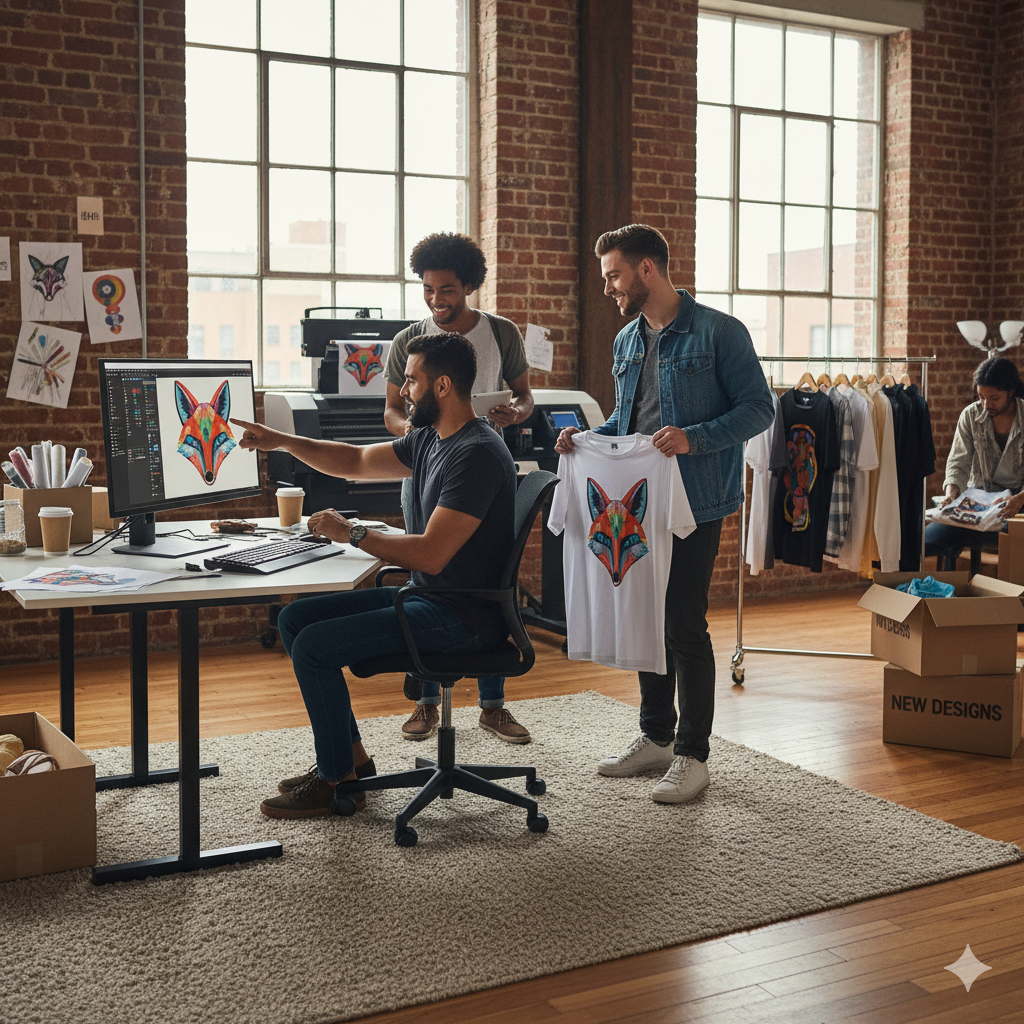
Shipping & Logistics — Full beginner’s playbook (step-by-step)
1) Quick overview — what shipping/logistics covers
- Packaging (how you wrap the product for safety and branding)
- Pickup (how courier collects parcel from you)
- Surface transit (movement between origin and destination hubs)
- Last-mile delivery (courier delivers to customer)
- Tracking & notifications (customer sees status)
- Returns / reverse logistics (customer returns)
- Cash collection (COD) and reconciliation
- Integration with your store (automating AWBs, tracking, invoices)
2) Step-by-step setup if you know nothing
Step 0 — What you need physically
- A weighing scale (0–5 kg digital) — ₹700–₹1,500.
- Tape, scissors, poly mailers or boxes, stickers, packing slips.
- Phone & WhatsApp for customer messages.
Step 1 — Decide packaging standard
Action:
- Choose poly mailers for tees (cheaper, light, good for non-fragile items). Use sizes: 10×13 in (small) or 12×15 in (medium).
- For premium orders use a small box with tissue paper + sticker + thank you card.
- Keep packaging cost target: ₹5–₹15 per order for mailer; ₹25–₹60 for box premium.
Why: Packaging affects courier cost (weight & size), first impression, and returns.
Step 2 — Weigh & measure every parcel
Action:
- Weigh the folded packaged tee on digital scale.
- Measure approx dimensions (L×W×H) for volumetric weight calculation if needed.
Why: Courier charges by actual weight or volumetric weight (whichever is higher). Get accurate numbers to avoid surprises.
Step 3 — Choose courier options (start with 2)
Action:
- Start with 1 aggregator + 1 direct courier:
- Aggregator (Shiprocket / Pickrr / Shipyaari / Shipyaar): easy on-boarding, multiple courier options, single panel to compare rates & print AWB. Good for <100 orders/day.
- Direct courier (Delhivery / Blue Dart / DTDC / Ecom Express / India Post): pick one familiar for your region.
- Sign up on aggregator first — they give access to multiple couriers and often better rates for low volumes.
Why: Aggregator reduces setup friction and helps compare speed vs cost.
Step 4 — Understand pricing components
- Base charge = per kg slab rate (e.g., ₹40–₹100/kg for standard metro to non-metro; varies).
- Fuel & handling surcharges — added by courier.
- COD fee if you offer Cash on Delivery (flat + % of order). Typical COD is ₹30–₹60 + 1–2% of order value.
- Reverse pickup / return shipping cost (₹60–₹120) — decide who pays (you or customer).
- Insurance (optional) — small % of order value if expensive.
Tip: For 0.4–0.6 kg apparel parcels, expect national courier cost roughly ₹40–₹120 depending on distance and service speed.
Step 5 — Decide your customer shipping policy
Pick one of these simple models:
- Flat shipping: charge ₹49 across India (simple).
- Free shipping above X: free over ₹799, else ₹49. (drives AOV)
- Dynamic (actual): show exact courier rate at checkout (best for accuracy).
Recommendation: Start with “Free shipping above ₹799 + flat ₹49 otherwise” (easy to explain).
Step 6 — Printing labels & pickup
Action:
- After order confirmed, create AWB (air waybill) on aggregator panel and print label.
- Stick AWB on parcel with clear tape (don’t cover barcode).
- Schedule pickup from courier same day or next morning (aggregators allow auto pickup).
- Hand over parcels to courier at pickup time.
Tip: Keep pickup cut-off time (e.g., 5:00 PM). Anything after goes next day.
Step 7 — Tracking & customer updates
Action:
- Send order confirmation + AWB number + tracking link via WhatsApp and Email immediately after dispatch.
Template:
“Hi [Name], your order #[123] has been shipped via [CourierName]. AWB: [XXXX]. Track: [link]. Expect delivery in 3–5 days.”
Why: Keeps customers happy and reduces ‘where is my order’ queries.
Step 8 — Handling COD payments & reconciliation
Action:
- If using COD, courier collects cash and remits per their schedule (usually weekly or bi-weekly).
- Keep record of AWBs & expected remittance amounts. Reconcile remittance vs orders weekly.
Tip: COD increases cancellation & returns. Aim to shift customers to prepaid (UPI, cards) with small discount (₹20 off) to reduce COD exposure.
Step 9 — Returns (reverse logistics) process
Action:
- Set clear return policy on site (7 days, unused, photo evidence for damage).
- For returns, generate reverse pickup via aggregator (cost charged to you or customer).
- On receipt, inspect item and approve refund or exchange. Log in returns sheet.
Tip: For defective items you bear return shipping; for size-change consider charging a small return fee or exchange only.
Step 10 — Scale decisions (when orders grow)
- At 30–50 orders/day consider fulfillment centers (3PL) — they store stock, pick, pack, ship for you. Good for scaling but costs apply.
- At 100+ orders/day negotiate direct contracts with courier for better rates & SLAs.
3) Packaging — exact practical checklist & templates
Minimum packing materials
- Poly mailers (100 pieces pack)
- Packing tape & dispenser
- Packing slip / invoice (printed or handwritten)
- Stickers/thank you card (optional)
- Waterproofing: always use polybag + mailer to prevent moisture damage
Packing steps (SOP)
- Fold tee properly; insert tissue if premium.
- Put in polybag; seal.
- Insert packing slip & return policy receipt.
- Place in mailer; seal securely with tape.
- Affix AWB label & fragile/sticker if needed.
- Store finished parcels in “Ready for Pickup” box by cut-off time.
Example packing cost (approx)
- Poly mailer: ₹5–₹8 each
- Packing slip print: ₹0.5 each
- Sticker + thank you card: ₹2–₹5 each
Total basic packaging ~ ₹8–₹14 per order.
4) Cost examples & mini-chart (real life estimates for India, per parcel)
Assume a single printed T-shirt parcel ~0.45 kg (packed).
| Item | Cost range (₹) | Notes |
|---|---|---|
| Poly mailer & slip | 5–14 | depends premium box vs mailer |
| Domestic courier (standard) | 40–120 | metro vs remote |
| COD fee (if enabled) | 30–80 | includes % fee |
| Reverse return (if needed) | 60–120 | per return |
| Insurance (optional) | 10–30 | % of order value |
| Total delivered cost (prepaid) | 45–130 | excl. packaging |
| Total delivered cost (COD) | 75–210 | incl. COD charges |
5) Choosing courier & service levels (how to decide)
Service types
- Standard (economy): cheaper, 4–7 days to non-metro.
- Express / Priority: faster, 1–3 days in metros.
- Free shipping (aggregated): best to set threshold and absorb cost for repeat buyers.
How to pick
- For small brands, prioritize: reliability > speed (trustworthy delivery reduces complaints).
- Use aggregator to test 2–3 couriers for your pin code sample orders (send 10 test orders to different pin codes) and compare actual delivery times and damage rates.
6) Integrations & automation (save time)
If you sell via Shopify/WooCommerce/Magento:
- Connect to aggregator (Shiprocket/Pickrr/Shipyaari) plugin — auto-create AWB, print bulk labels, auto-update tracking.
- For marketplaces (Amazon/Flipkart), use their inbuilt shipping or integrate if API allowed.
Why: Saves manual AWB creation and reduces human error.
7) International shipping (if you want to export later)
Steps & docs:
- Get IEC (Import Export Code) from DGFT.
- Use courier services like DHL / FedEx / UPS / India Post (EMS) for small parcels.
- Declare customs invoice & HS code (t-shirt HS code common: 6109 for cotton).
- Consider duties, taxes, and shipping insurance.
Note: International shipping costs are high; start with a few pre-orders or test via marketplaces like Etsy.
8) Fraud, RTO, and prevention hacks
Problems: high Return-to-Origin (RTO) when COD orders are not accepted.
Prevention:
- Charge small advance for COD orders (₹50 refundable) — reduces casual COD orders.
- Use phone verification for first-time COD orders.
- Limit COD for high-risk pin codes.
- Offer small prepaid discount to move buyers to prepaid.
9) Metrics to track (KPIs)
Track weekly:
- On-time delivery rate (target >95%)
- Damaged in transit rate (target <1%)
- RTO rate (target <5% for prepaid; COD can be 10–15% initially)
- Average shipping cost per order (track trends)
- Refund time (target <3 business days after receiving return)
10) Customer communication templates (copy-paste)
Order shipped:
Hi [Name], your order #[123] has been shipped via [Courier]. AWB: [AWB]. Track: [link]. Expected in 2–5 days. Reply if you need help.
Delay apology:
Hi [Name], we’re sorry — your parcel #[123] is delayed due to [reason]. Expected delivery: [date]. We’ll update you as soon as it’s out for delivery. Apologies for the inconvenience.
Return approved:
Hi [Name], we have received the returned parcel #[123] and approved replacement/refund. Amount ₹[x] will be refunded to your UPI/bank within 3 days. Thank you for your patience.
11) First 30-day checklist (do these exactly)
Day 1–3:
- Buy scale, mailers, tape, printing labels.
- Sign up on one aggregator panel (Shiprocket/Pickrr) and one local courier.
Day 4–7:
- Create packing SOP & print 20 test labels.
- Do 10 test shipments to various pin codes and record delivery times.
Day 8–15:
- Finalize shipping policy (flat vs free-above). Add policy to website.
- Set up automated order/shipment messages (WhatsApp template + email).
Day 16–30:
- Monitor KPIs weekly; adjust courier split based on performance.
- Start negotiating rates if volume grows (ask aggregator rep).
12) Scaling: when & how to move to 3PL / fulfillment
Signs to move:
- You consistently ship 30–50+ orders/day; packing & dispatch consumes your time.
- You want to free time for marketing/operations.
3PL benefits:
- They pick, pack, store, and ship; can offer faster lead time & bulk discounts.
How to choose 3PL:
- Compare rates, SLA, tech integration, return handling, and storage fees.
- Start with 1 month trial, monitor errors.
13) Final practical tips & founder hacks
- Always add tracking to customer messages — reduces support queries by 50%.
- Keep a 2-day buffer stock of high-selling SKUs near your packing area for same-day dispatch.
- Use protective polybag + clear tape over AWB to prevent smudging.
- Label fragile if you include prints that could crease (rare).
- Bulk print AWBs at morning and have courier pickup scheduled to avoid daily trips.
- Document every exception (misship, damage) and discuss with courier rep monthly.
💸 1️⃣ PRICING PRESSURE & COMPETITION — FULL BREAKDOWN
🔍 Problem Overview:
T-shirt printing is a highly competitive, low-margin industry. Online and offline sellers often fight on price.
New owners think they must “be cheapest to win,” but that approach kills brand value and profit.
🧱 Step-by-Step Breakdown
Step 1 — Understand Market Pricing Structure
| Type of Seller | Selling Price (₹) | Notes |
|---|---|---|
| Local print shop | 250–400 | Small batches, high overhead |
| Instagram / D2C brand | 499–999 | Branded + niche |
| Amazon / Flipkart seller | 299–599 | Bulk, low margin |
| Premium niche brand | 799–1,499 | Heavy GSM, story branding |
👉 Your job: decide which category you fit in.
If you’re a niche brand (motivational, anime, fitness, streetwear) — you can price ₹699–₹999 even with low investment.
Step 2 — Know Your True Cost (COGS)
Example for one printed T-shirt (outsourced printing model):
| Component | Cost (₹) |
|---|---|
| Blank tee (180 GSM combed cotton) | 100 |
| Printing (DTF or screen) | 50 |
| Packaging (poly + tape + thank-you card) | 10 |
| Courier (average) | 60 |
| Marketing (ad / influencer avg.) | 30 |
| Misc. (electricity, tape, losses) | 10 |
| Total cost per tee | 260 |
👉 Selling price = ₹699 → Profit margin = ₹439 gross (~60%)
After taxes & returns → ~40–45% net.
If you buy a printing machine later, your cost may drop ₹30–₹40 per tee.
Step 3 — Avoid the “Cheap Price Trap”
If you keep reducing prices:
- You attract deal-seekers, not loyal fans.
- Returns and complaints increase (cheap perception).
- You can’t spend on marketing or quality.
✅ Instead, add value instead of discounts:
- Offer free stickers / postcards / handwritten note.
- Bundle deals (“Buy 2 Get ₹100 Off”).
- Limited-edition designs → create demand.
- Offer pre-booking or early-bird pricing.
Step 4 — Create a “Value Ladder”
| Tier | Product | GSM / Quality | Price (₹) |
|---|---|---|---|
| Entry | Basic Cotton Tee | 160 GSM combed | 499 |
| Mid | Premium Print | 180 GSM bio-wash | 699 |
| High | Oversized / Streetwear | 220 GSM enzyme | 999–1,299 |
✅ Benefit: Different customer budgets, stable brand image.
✅ Example: A customer who buys ₹499 tee today might upgrade to ₹999 later when they trust your brand.
Step 5 — Build Differentiation (so you can charge more)
- Focus on unique niche (e.g., “Funny Worklife Quotes”, “Street Style Oversized”, “Pet Lovers’ Tees”).
- High GSM + unique designs + story = pricing power.
- Brand identity (logo, tag, packaging) creates trust.
- Use storytelling: show behind-the-scenes videos (“Printed fresh this morning in our workshop!”).
Step 6 — Study Competitors Smartly
How to analyze:
- Search “Printed T-shirt” on Instagram & Amazon.
- Note top 10 competitor price ranges & followers.
- Order 1–2 of their tees → feel quality, packaging, tag.
- Note their shipping speed & design quality.
- Learn what they do right — and do 1% better in your way.
Step 7 — Practical Tips to Handle Pricing Pressure
✅ Offer loyalty coupons to existing buyers (repeat = profit).
✅ Do small “drops” instead of huge inventory (no unsold stock).
✅ Build community: WhatsApp group / Discord / Instagram close friends.
✅ Focus on lifetime customer value (LTV), not just first order.
✅ Don’t copy — innovate in theme or storytelling.
Step 8 — Summary Chart
| Issue | Mistake | Real Fix |
|---|---|---|
| Low sales → reduce price | Competes with everyone | Increase perceived value |
| Competitor selling cheap | Blindly match them | Offer better design/packaging |
| Small order volume | Blame market | Build micro-niche followers |
| Poor profits | Miscalculate cost | Track exact COGS & add 40% margin |
🚀 2️⃣ SCALING CHALLENGES — REAL-WORLD GROWTH PLAN
Once sales start increasing (20–100+ orders/day), new problems appear — space, consistency, fulfillment, cash flow, team, and systemization.
Let’s go step-by-step.
🔹 Step 1 — Identify Growth Stage
| Stage | Monthly Orders | Focus |
|---|---|---|
| Startup | 0–100 | Testing niche, building systems |
| Growth | 100–500 | Process automation, vendor stability |
| Expansion | 500–2,000+ | Hiring, branding, scaling production |
🔹 Step 2 — Challenges in Scaling & Solutions
1. Space & Storage
- Problem: Can’t manage 100+ T-shirts, no proper racks.
- Solution:
✅ Use vertical racks or under-bed storage bins.
✅ Categorize inventory (S, M, L, XL).
✅ Outsource printing & store blanks only.
✅ Once crossing 500 orders/month, rent small 10×10 godown (~₹5–8K/month).
2. Production Bottleneck
- Problem: Printing vendor delays or machine capacity limit.
- Solution:
✅ Have 2–3 print vendors as backup.
✅ Buy an extra heat press (₹10–20K) once orders stable.
✅ Keep a weekly production schedule.
✅ Start training one helper early.
3. Order & Inventory Management
- Problem: Manual confusion (who ordered what, which design printed).
- Solution:
✅ Use simple Google Sheet or software (Zoho Inventory / Sortly).
✅ Label each tee SKU + design.
✅ Automate with Shopify + Shiprocket integration.
✅ Maintain reorder point for blanks.
4. Cash Flow Crunch
- Problem: All profit locked in stock or courier float.
- Solution:
✅ Keep at least 20% of revenue as safety cash.
✅ Offer prepaid discounts to reduce COD float.
✅ Use MSME loans (Mudra, SIDBI) when scaling.
✅ Negotiate 30-day vendor credit.
5. Quality Consistency
- Problem: Scaling quickly → inconsistent printing or fabric.
- Solution:
✅ Fix a standard GSM (e.g., 180 GSM bio-wash for main line).
✅ Maintain a “master sample rack.”
✅ Audit every new batch; reject defects before printing.
6. Team Building
- Problem: Founder does everything → burnout.
- Solution:
✅ Hire part-timer for packing first (₹6–8K/month).
✅ Next hire designer/freelancer for social media.
✅ Create SOPs (standard operating procedures) for packing, shipping, returns.
✅ Use WhatsApp group for internal team updates.
7. Technology & Automation
- Problem: Manual tasks waste time.
- Solution:
✅ Automate invoices & AWBs via Shopify or Shiprocket.
✅ Use Canva templates for design updates.
✅ Use Google Drive for storing all designs, SOPs, and supplier info.
✅ Integrate payment + CRM (HubSpot free / Notion templates).
8. Customer Experience
- Problem: As orders grow, service quality drops.
- Solution:
✅ Auto-send messages for order confirmation & shipping.
✅ Use “thank you” email or WhatsApp template.
✅ Encourage reviews & UGC (User Generated Content).
✅ Offer loyalty points or coupons.
9. Marketing Scaling
- Problem: You can’t handle all social media manually.
- Solution:
✅ Schedule posts via Meta Suite / Later / Buffer.
✅ Use one campaign per month: “New Drop” or “Festive Edition.”
✅ Collaborate with small influencers regularly.
✅ Run remarketing ads only after 500+ orders (low cost, high ROI).
10. Leadership & Mindset
- Problem: You get overwhelmed by operations.
- Solution:
✅ Every Sunday → review metrics: orders, returns, profit, followers.
✅ Focus on systems, not just sales.
✅ Automate, delegate, and document.
✅ Remember: scaling = simplifying, not complicating.
🔹 Step 3 — Scaling Cost Snapshot (Real-life Example)
| Growth Item | Approx Monthly Cost (₹) | When to Add |
|---|---|---|
| Packing helper | 6,000–8,000 | 100+ orders/month |
| Small warehouse / office | 6,000–10,000 | 300+ orders/month |
| Shopify advanced plan | 2,000–3,000 | 200+ orders/month |
| Printer upgrade / machine | 60,000–1,20,000 | 500+ orders/month |
| Advertising budget | 5,000–15,000 | ongoing |
| Freelancer designer | 5,000–10,000 | any stage |
| Accounting & GST help | 3,000–6,000 | any stage |
🔹 Step 4 — Scaling Framework Summary
| Stage | Focus | Tools |
|---|---|---|
| Start | Test niche + manual system | Excel, WhatsApp, Indiamart |
| Grow | Build brand + automate basics | Shopify, Shiprocket, Canva |
| Scale | Team, multiple channels, vendor network | Zoho, Notion, Meta Ads |
💼 All Difficulties Faced by a T-Shirt Printing Business Owner (With Solutions)
⚙️ 1️⃣ Product Quality & Raw Material Confusion
🧩 Problem:
You don’t know how to identify good-quality T-shirts. Vendors often mix fabrics (poly-cotton, low GSM) and claim it’s “premium.”
Bad quality leads to poor prints, shrinking after wash, and negative reviews.
💡 Solution:
- Learn GSM basics:
- 160 GSM → Lightweight daily wear (budget segment)
- 180 GSM → Standard quality (best for startups)
- 220 GSM → Premium oversized streetwear
- Always buy bio-wash or enzyme-wash cotton (soft and long-lasting).
- Buy from verified wholesalers on Indiamart, Textile Export, or Tirupur Market (Tamil Nadu).
- Ask for 1 sample from each vendor before bulk order.
- Check by:
- Pull/stretch test (cloth returns to shape → good)
- Wash once & dry → check for color fade or shrink
- Print one test sample
✅ Keep a Quality Control Sheet (Vendor name, GSM, feel, shrink test results).
🏭 2️⃣ Printing & Production Issues
🧩 Problem:
If you outsource printing, sometimes vendors delay or misprint your design.
If you print yourself, machine setup and maintenance take time and skill.
💡 Solution:
- Start with outsourcing (DTF / screen printing) for first 3–4 months.
- Maintain 2–3 reliable vendors (so if one fails, second can help).
- For your own setup:
- Basic heat press – ₹15,000–₹20,000
- DTF printer – ₹70,000–₹1,50,000
- Watch YouTube tutorials (e.g., PrintsVilla, InkSaga India).
- Use a production logbook (which design, how many prints, date).
- Always test print before full batch.
✅ Keep backup blank T-shirts ready for emergency reprints.
📦 3️⃣ Inventory & Space Constraints
🧩 Problem:
You don’t have a warehouse or much space.
Managing sizes (S, M, L, XL) becomes confusing.
Unsold designs take up space.
💡 Solution:
- Start with small batches (20–30 pcs per design).
- Store by size: use bins or boxes labeled (S/M/L/XL).
- Keep designs that sell → discontinue slow ones.
- Use free apps like Sortly or Google Sheets for stock tracking.
- Once you cross 300+ monthly orders → rent small storage room (₹6K–₹8K/month).
✅ Focus on “Print on Demand” model in early months — no stock, just print after order.
💰 4️⃣ Cash Flow & Pricing Struggles
🧩 Problem:
You run out of cash due to bulk stock purchases or courier costs.
COD orders take long to settle.
Profit margin feels too low.
💡 Solution:
- Calculate COGS (Cost of Goods Sold) properly:
- T-shirt cost + printing + courier + packaging + marketing
- Keep minimum 40% profit margin over cost.
- Encourage prepaid payments (10% off for prepaid).
- Reinvest 70% of profits, keep 30% as backup cash.
- Apply for Mudra Loan (up to ₹10 Lakh) under MSME.
👉 Apply here
✅ Don’t buy in bulk early — buy as per weekly sales.
🌐 5️⃣ Website & Technical Challenges
🧩 Problem:
No experience in websites or online selling.
Don’t know how to connect payment gateway or courier.
💡 Solution:
- Use Shopify (₹2,000/month) or Dukaan (₹1,000/month).
- Use templates – no coding needed.
- Connect:
- Payment Gateway → Razorpay or PayU
- Courier Partner → Shiprocket or NimbusPost
- Use Instagram Shop + WhatsApp Button to drive traffic.
✅ Keep your website minimal: Home | Shop | About Us | Contact | Return Policy.
📦 6️⃣ Shipping & Logistics Problems
🧩 Problem:
Delay in courier pickups, high shipping costs, or lost parcels.
💡 Solution:
- Partner with Shiprocket, NimbusPost, or Pickrr for cheapest multi-courier service.
- Average cost per parcel (200g) = ₹50–₹70.
- Always double pack and include invoice + thank-you note.
- Enable tracking SMS/email for customer.
- Track all returns weekly to prevent loss.
✅ For faster delivery → choose nearest courier hub city (Delhi, Mumbai, Bangalore).
📣 7️⃣ Marketing & Promotion Challenges
🧩 Problem:
Low visibility — you don’t know how to market your brand with a small budget.
💡 Solution:
- Start free:
- Instagram Reels, Pinterest, WhatsApp Broadcast.
- Collaborate with small influencers (500–2K followers).
- Post customer photos (UGC = social proof).
- Paid low-cost:
- Run ₹200/day Instagram Ads (₹6K/month).
- Offer referral coupons to your customers.
- Long-term:
- Create brand story (“Made for the Hustlers”, “Your Mood on a Tee”).
- Start your own “Design of the Week” drop.
✅ Focus more on storytelling than discounting.
💬 8️⃣ Customer Service & Returns
🧩 Problem:
Late replies or poor handling of returns kills your reputation.
💡 Solution:
- Use WhatsApp Business for quick replies.
- Template messages:
“Hi 👋, thanks for contacting [Your Brand]. Your order is on the way 🚚. Here’s the tracking link: …” - Create a simple return policy:
- Only damaged/wrong print accepted within 7 days.
- Use Google Form to collect return details.
- Offer small replacement gifts for delayed orders.
✅ Build trust → happy customers become your free promoters.
🔄 9️⃣ Vendor Reliability Issues
🧩 Problem:
Fabric or print vendors disappear, delay, or change quality after 2–3 orders.
💡 Solution:
- Never depend on one vendor.
- Always pay 50% advance, 50% after inspection.
- Maintain list of alternate suppliers from Indiamart.
- Build strong relation — visit them personally once.
✅ Make a contract or WhatsApp written agreement for delivery terms.
💻 🔟 Scaling & Team Challenges
🧩 Problem:
As orders grow, you can’t handle everything — marketing, printing, packing, delivery.
💡 Solution:
- Hire part-time packer first (₹6–8K/month).
- Use Google Sheets for order tracking.
- Automate invoices & shipping labels (Shopify + Shiprocket).
- Hire freelancer designers from Fiverr (₹500–₹1,000/design).
- Document your daily process → create SOPs.
✅ Growth = system + delegation, not only sales.
📊 11️⃣ Legal & Documentation Problems
🧩 Problem:
You’re not sure what documents you need for a legal business setup.
💡 Solution:
| Document | Purpose | Apply Link |
|---|---|---|
| GST Registration | To collect tax | https://www.gst.gov.in/ |
| Udyam (MSME) | To register small business | https://udyamregistration.gov.in/ |
| Trademark | Protect brand name/logo | https://ipindia.gov.in/ |
| Shop Act License | Local business permit | State-wise municipal website |
| PAN & Bank Account | Financial compliance | Your bank |
| IEC Code (if export) | For international shipping | https://www.dgft.gov.in/ |
✅ Keep all digital copies organized in Google Drive.
⚡ 12️⃣ Mental & Motivation Challenges
🧩 Problem:
Sales fluctuate, friends doubt you, you lose motivation after slow months.
💡 Solution:
- Remember: every big brand had slow start.
- Focus on progress (not perfection).
- Network with other sellers (Instagram groups, YouTube communities).
- Celebrate small wins — first 10 orders, 100 followers, etc.
- Keep learning and improving — don’t chase instant success.
✅ Growth happens when you stay consistent, not when you go viral.
🧭 Summary Table — Difficulties vs Solutions
| Category | Common Difficulty | Practical Solution |
|---|---|---|
| Product | Low quality fabric | Test GSM, sample first |
| Printing | Vendor delays | Keep backups |
| Inventory | No space | Print-on-demand, small batches |
| Pricing | Low margins | Add value, not discount |
| Cash Flow | COD delay | Encourage prepaid |
| Marketing | Low reach | Organic + influencer collab |
| Shipping | Delay/damage | Use Shiprocket |
| Customer Care | Slow replies | WhatsApp Business templates |
| Scaling | Overload | Hire, automate, SOPs |
| Legal | Confusion | GST, MSME, Trademark registration |
| Motivation | Inconsistency | Focus on long-term growth |
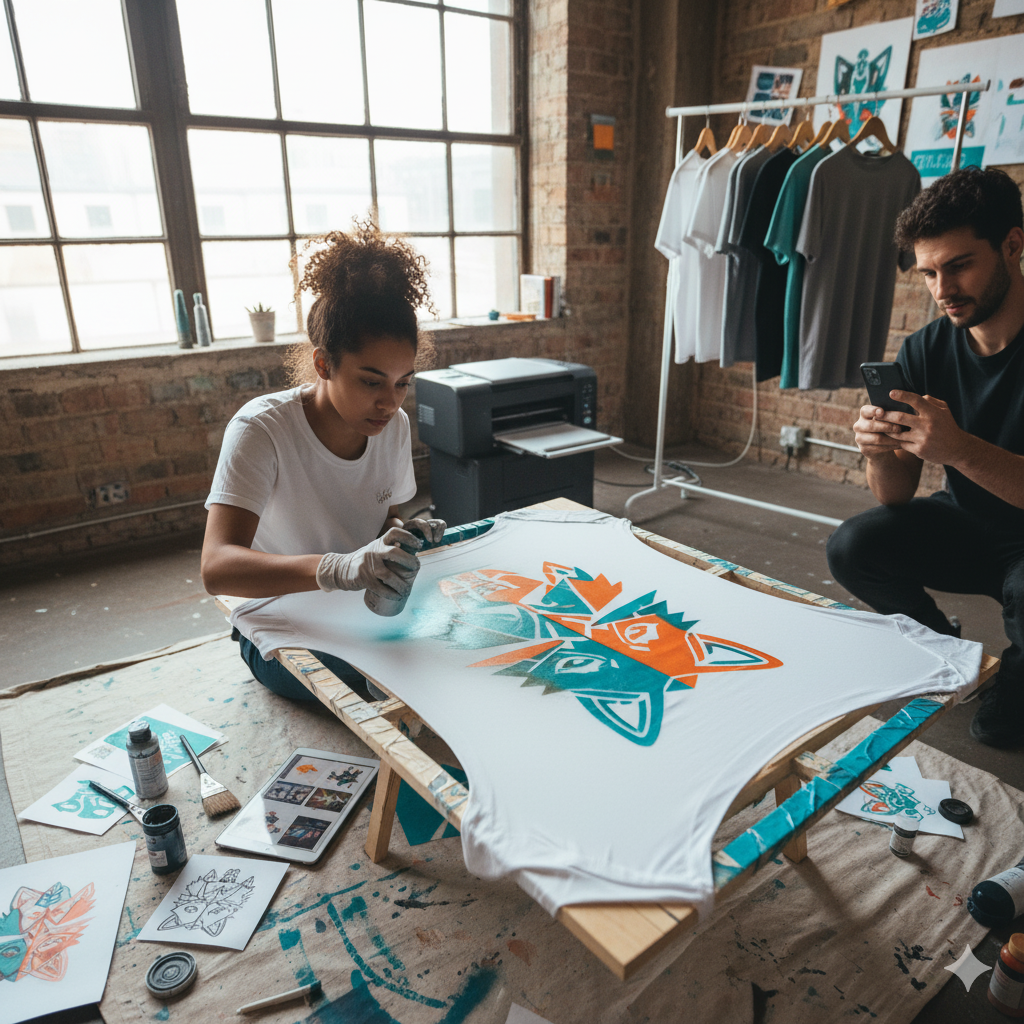
🧾 1. PRICING PRESSURE & COMPETITION
⚠️ The Challenge:
In India’s T-shirt printing market, competition is extremely high — especially online. You’ll compete with:
- Big brands (Bewakoof, The Souled Store, Printo, etc.)
- Local custom T-shirt shops
- Small Instagram stores offering cheaper rates
This leads to pricing pressure, where customers expect premium quality at the lowest price, and it’s hard to maintain profit margins.
💣 Real Problems You’ll Face:
- Competitors offering very low prices (₹250–₹350 per custom T-shirt).
- Customers bargaining or asking for discounts.
- High material & printing cost, leaving less profit.
- Delivery charges reducing your margin.
- High returns or exchanges due to size/print issues.
🧭 Step-by-Step Solution:
Step 1: Know Your True Cost
Make a simple chart like this 👇
| Cost Type | Average Cost (₹) | Notes |
|---|---|---|
| Blank T-shirt (180–200 GSM Cotton) | ₹160 | Bulk purchase (from Tirupur/Ludhiana) |
| Printing (DTF or Screen) | ₹60 | Outsourced |
| Packaging | ₹15 | Branded box/paper bag |
| Delivery (courier) | ₹50 | Shiprocket or Delhivery |
| Marketing Cost per order | ₹30 | Instagram or WhatsApp ads |
| Total Cost | ₹315 | — |
| Selling Price | ₹499 | Online retail |
| Profit per T-shirt | ₹184 | Before tax |
👉 Pro tip: Always know your minimum profitable selling price (break-even point).
Step 2: Create a Niche
You can’t compete with everyone — stand out with:
- Funny / relatable quotes (for youth)
- Gym / fitness themes
- Pet lovers’ tees
- Custom birthday or couple T-shirts
- Corporate bulk orders (more stable)
👉 Example: “Desi Meme Tees” can dominate Instagram for humor lovers.
Step 3: Add Perceived Value
Increase your product’s perceived value without increasing cost:
- Premium packaging (₹5–₹10 extra)
- Branded tag + thank-you card
- Limited edition drops (“Only 100 prints!”)
- Collaborations with micro-influencers
Step 4: Build Loyalty
Instead of reducing price:
- Offer loyalty points or coupons for next order.
- Provide personalized prints (name/logo customization).
- Encourage repeat customers via WhatsApp broadcast.
Step 5: Focus on B2B/Bulk Orders
Approach:
- College fests
- Gym owners
- Corporate teams
- Event organizers
These orders bring bulk revenue and stable demand (100–500 T-shirts per order).
✅ Summary – Pricing Pressure Solutions Chart
| Problem | Solution |
|---|---|
| Competitors sell cheaper | Niche branding + storytelling |
| Low profit margins | Know cost & set minimum price |
| Customers demand discounts | Offer loyalty or combo deals |
| Expensive shipping | Use Shiprocket bulk plan |
| High returns | Strict size chart + product video before dispatch |
🚀 2. SCALING CHALLENGES
⚠️ The Challenge:
Once you start getting 30–100+ orders per month, new issues appear:
- Inventory management
- Order tracking
- Hiring help
- Maintaining quality across volume
- Expanding into new cities or platforms
🧭 Step-by-Step Scaling Plan:
Step 1: Automate Order Management
Use low-cost tools:
- Google Sheets + Form (free) for manual tracking.
- Shopify or Wix – auto tracks orders, inventory & shipping.
- Shiprocket / Pickrr – automate courier and updates.
💡 Example: You get 20 orders daily. Instead of writing addresses manually, integrate Shopify + Shiprocket to print labels and send SMS updates automatically.
Step 2: Outsource Non-Core Tasks
Outsource gradually:
| Task | Outsource To | Cost |
|---|---|---|
| Printing | Local DTF vendor | ₹50–₹80 per tee |
| Packaging | Local labor (part-time) | ₹200–₹300/day |
| Delivery | Shiprocket / Amazon Easy Ship | Pay per parcel |
Step 3: Expand Online Presence
Start with Instagram & WhatsApp, then:
- Register on Meesho, Amazon, Flipkart.
- Create Shopify store (₹2000/month).
- Add Google My Business for local pickup orders.
This step helps you reach pan-India buyers without opening new stores.
Step 4: Build Micro-Team
Once revenue crosses ₹50,000–₹1 lakh/month:
- Hire a printing operator
- Hire a social media intern
- Keep one delivery/packaging helper
You can start from a small 100–200 sq ft room.
Step 5: Introduce New Products
Scale vertically:
- Hoodies, tote bags, mugs, caps, phone covers
Scale horizontally: - Same print across different products
✅ Summary – Scaling Challenges & Solutions Chart
| Challenge | Solution |
|---|---|
| Managing increasing orders | Use Shopify/Shiprocket automation |
| Maintaining quality | Standardize T-shirt GSM and vendor |
| Storage limitation | Just-in-time inventory (order after demand) |
| Time shortage | Hire part-timers or interns |
| Expanding reach | List on multiple platforms (Meesho, Flipkart, Amazon) |
| Capital shortage | Reinvest profits; avoid EMI for machines early |
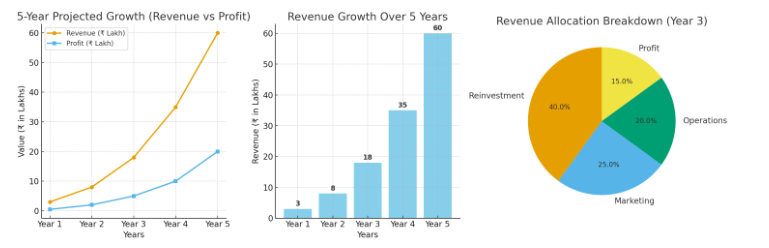
Here’s the 5-year projected growth visualization for your T-shirt printing business:
- 📈 Line Chart: Shows how revenue could grow from ₹3 L in Year 1 to ₹60 L by Year 5, with profit increasing steadily as operations stabilize.
- 📊 Bar Chart: Highlights annual revenue expansion through marketing, brand identity, and bulk orders.
- 🥧 Pie Chart: Demonstrates how your income might be allocated in Year 3 — 40% reinvestment, 25% marketing, 20% operations, 15% profit.
🚀 High Growth Possibility (If Done Well)
If you execute strategically with consistent branding, customer engagement, and cost control:
- You can achieve 10× growth in 5 years.
- By Year 3, the brand could reach ₹15–20 L annual turnover with small team & online presence.
- By Year 5, with proper marketing and repeat customers, ₹50–60 L+ revenue is achievable.
💡 Key Drivers of High Growth:
- Niche Selection: Focus on viral or emotional themes (memes, youth, gym, couples).
- Automation: Early use of Shopify, Shiprocket, and inventory tools.
- Bulk & B2B Orders: Target colleges, startups, and events.
- Social Media Power: Use reels, influencer tie-ups, and limited-edition drops.
- Customer Loyalty: Build repeat sales with WhatsApp/Email marketing.
💼 Investor Pitch Deck: Trendify Threads (Example Brand Name)
A modern custom T-shirt printing startup blending design, culture & personalization.
🧩 1. Executive Summary
- Business Name: Trendify Threads
- Founded By: [Your Name]
- Business Type: D2C (Direct-to-Consumer) T-shirt printing brand
- Business Model: Online + Offline + B2B orders
- Target Market: Gen-Z, college students, startup teams, events, gym enthusiasts
- Current Stage: Bootstrapped, profitable on small scale, seeking seed funding to scale.
- Funding Required: ₹15–20 Lakhs
- Use of Funds: Marketing, inventory, automation, team expansion
🧠 2. Problem Statement
Most youth customers love trendy, relatable T-shirts — but current brands either:
- Overprice products, or
- Offer poor quality & slow delivery.
Gap: Lack of affordable, premium-quality personalized T-shirts with quick delivery & strong Indian themes.
💡 3. Our Solution
We provide:
- Premium 180–200 GSM cotton T-shirts with custom & trendy prints
- Print-on-demand service for individuals & small businesses
- 1–3 day delivery across India via Shiprocket / Delhivery
- Online personalization tool for name/logo design
📊 4. Market Opportunity
| Segment | Value (2024) | CAGR Growth | Target |
|---|---|---|---|
| Indian T-shirt Market | ₹25,000+ Crores | 10–12% | Fashion & gifting |
| Custom Printing Market | ₹4,500 Crores | 20% | Youth, Startups, Gifting |
| E-commerce Growth | ₹8 Lakh Crores | 18% | Urban & Tier-2 cities |
🎯 We target a ₹1 Cr+ revenue in 3 years with 40% gross margin.
🧱 5. Business Model
| Revenue Stream | Description | Example |
|---|---|---|
| D2C Sales | Via website, Instagram, WhatsApp | TrendifyThreads.in |
| B2B Orders | For companies, colleges, events | Bulk of 100–1000 pcs |
| Custom Printing | For birthdays, couples, gym teams | ₹499–₹799 per tee |
| Merchandise Licensing | Partner with creators/influencers | Profit sharing |
💰 6. Revenue Projection (5 Years)
| Year | Revenue (₹ Lakh) | Profit Margin | Notes |
|---|---|---|---|
| 1 | 3 | 10% | Brand setup, low profit |
| 2 | 8 | 20% | Local brand recognition |
| 3 | 18 | 25% | Pan-India orders |
| 4 | 35 | 30% | Automation, bulk orders |
| 5 | 60 | 35% | Full brand scale-up |
⚙️ 7. Use of Funds
| Purpose | Allocation % | Amount (₹ Lakhs) |
|---|---|---|
| Marketing & Branding | 30% | 6 |
| Inventory & Machinery | 25% | 5 |
| Website & App | 15% | 3 |
| Logistics & Operations | 10% | 2 |
| Working Capital | 20% | 4 |
| Total | 100% | 20 Lakhs |
💬 8. Marketing Strategy
- Instagram & Reels – Creative short videos on trends
- Influencer Tie-Ups – Micro creators with 10–50k followers
- WhatsApp Automation – Repeat customer campaigns
- Offline Pop-Up Stalls – College fests, flea markets
- Referral Program – “Refer & Earn” coupons
🧍 9. Team
| Role | Responsibility |
|---|---|
| Founder | Business, Marketing & Vision |
| Co-founder (Optional) | Operations & Logistics |
| Printing Partner | Design & production |
| Marketing Intern | Content & social media |
| Delivery Partner | Shipping (Shiprocket/Delhivery) |
🏆 10. Competitive Advantage
| Factor | Trendify Threads | Competitors |
|---|---|---|
| Printing Quality | 200 GSM cotton | Mixed |
| Delivery Time | 1–3 days | 5–7 days |
| Personalization | Yes | Limited |
| Price | ₹499 avg | ₹699+ |
| Brand Personality | Youthful, meme-based | Generic |
📈 11. Traction (Expected)
- 10,000+ organic followers by Year 2
- 1,000+ repeat customers
- Tie-ups with 10 colleges, 5 startups
- Monthly orders: 500+ units by Year 3
📬 12. Exit or Growth Plan
- Expand into hoodies, tote bags, caps
- Collaborate with influencer brands
- Launch own warehouse or printing setup
- Sell stake or merge with apparel platform in Year 5+
💰 WHERE TO FIND INVESTORS (WITH APPLY LINKS)
Here are real platforms & incubators in India you can apply directly for startup funding or mentorship 👇
| Platform | Type | Website / Apply Link |
|---|---|---|
| Startup India | Govt Recognition + Funding Support | https://www.startupindia.gov.in/ |
| AngelList India | Angel investors & early-stage startups | https://angel.co/india |
| India Accelerator | Mentorship + seed fund | https://indiaaccelerator.co/ |
| LetsVenture | Startup fundraising platform | https://letsventure.com/ |
| Venture Catalysts | Early-stage investment network | https://venturecatalysts.in/ |
| 100X.VC | Pre-seed fund, invests ₹1.25 Cr per startup | https://www.100x.vc/ |
| CIIE.CO (IIM Ahmedabad) | Incubation & investor access | https://ciie.co/ |
| Shark Tank India | TV funding platform | https://sharktank.sonyliv.com/ |
| SIDBI Fund of Funds | Govt MSME funding support | https://www.sidbi.in/ |
🧭 How to Apply – Step-by-Step:
- Register your company (as OPC/LLP/Pvt Ltd on MCA Portal)
- Get Startup India recognition
- Prepare Pitch Deck + Financial Projection PDF
- Apply on 2–3 investor platforms (like AngelList, 100X.vc)
- Present your pitch via email or virtual meet
- Negotiate equity (usually 10–20% for early-stage)
90-Day Low-Cost Marketing Plan to Acquire Customers
Brand: Trendify Threads (example) Goal (first 90 days): Validate product-market fit, acquire first 500 customers, collect 300 UGC posts/reviews, establish 3 stable marketing channels.
Overview — strategy in one line
Start hyper‑niche, use organic social + community tactics, convert with frictionless checkout (WhatsApp/Shopify), and scale winners with small paid tests. Focus on UGC, micro‑influencers, campus reps, and marketplaces.
Month 0 (Pre-launch week)
Objectives: Set up assets, collect beta testers, prepare creative.
Tasks (day-by-day quick list):
- Day 1: Finalize 6 hero SKUs (colors/sizes) and set landing page (Shopify/WooCommerce) with WhatsApp button.
- Day 2: Create brand kit (logo, colors, 3 fonts), write 3 taglines, prepare size chart and return policy.
- Day 3: Shoot 20 product photos (natural light) + 6 short reels (timelapse, unboxing, printing). Use phone only.
- Day 4: Set up Instagram, Facebook, WhatsApp Business, Google Business Profile, and a Linktree-like page.
- Day 5: Create 3 post templates in Canva (product, BTS, UGC repost).
- Day 6: Build a 1-page order form (Google Form) for beta orders; plan “friends & family” discount 25%.
- Day 7: Seed 30 beta invites via DMs, WhatsApp & close friends; collect testimonials from first 10 buyers.
Free tools to use: Canva, InShot (video), Buffer free/Meta Creator Studio, Google Forms, Linktree.
Month 1 — Launch & Organic Traction (Weeks 1–4)
Objectives: Acquire first 100–200 paying customers, capture UGC, test pricing and shipping.
Weekly rhythm
- 3 posts / week (2 photos + 1 reel)
- Daily stories: polls, countdowns, BTS clips
- One micro-campaign per week (UGC contest, flash sale, campus rep recruitment)
Campaigns & Actions
- Soft Launch (Week 1)
- Offer: “Launch Special — ₹100 off first order + free shipping above ₹799”.
- Channels: Instagram Feed + Reels, WhatsApp broadcast to contacts, share in local FB groups and college WhatsApp groups.
- KPI: 50 orders
- Script (DM outreach):Hi [Name]! We’re launching Trendify Threads — doing premium 180 GSM tees with quirky designs. Launch offer: ₹100 off. Want one at sample price? Reply with size & city, I’ll reserve it. — [Your name]
- UGC Push (Week 2)
- Ask buyers to post a photo tagging @brand + hashtag #MyTrendify. Offer ₹50 off next order.
- Share best 10 UGC in highlights. Incentivize first 50 UGC with a monthly feature and ₹250 giveaway.
- Template (story request):Loved your tee? Post a picture + tag @TrendifyThreads to get ₹50 off your next order. We’ll feature the best shots and gift one winner ₹500 monthly!
- Micro‑influencer Collab (Week 3)
- Target local micro creators (5–10k followers) — offer product-for-post or 10% commission links.
- Outreach script:Hey [Influencer], love your feed — would you like to style a free tee from Trendify Threads? We can give you a unique code for 10% off + 10% commission. Interested? Send size & address.
- Market Listing & Local Sales (Week 4)
- List 6 SKUs on Meesho and Instagram Shop.
- Do a weekend stall/pop‑up at a local flea market or college (cost ₹500–₹2,000). Use live printing demo if possible.
Measurement (end of Month 1)
- Orders: target 100–200
- UGC: 100 posts
- Social followers: 2,000+ (organic + influencers)
- CAC: track ad test (if any)
Month 2 — Optimize & Scale Organic (Weeks 5–8)
Objectives: Improve conversion, test small ad spends on winners, recruit campus reps, secure 5 B2B leads.
Weekly rhythm
- 4 posts / week (2 photos, 2 reels)
- 2 email/WhatsApp broadcasts / week (new drop, limited stock)
Campaigns & Actions
- Campus Rep Program (Week 5)
- Recruit 10 students across 5 colleges. Commission ₹50–₹100 per sale or merchandise for top sellers.
- Rep onboarding script: share 10 designs, pricing, order process, tracking sheet.
- Rep pitch message to students:Join Trendify Campus Reps — earn ₹50 per sale + free tee for 10 sales. DM to join.
- Micro paid tests (Week 6)
- Run ₹300/day Meta/Instagram ad for 5 days on 1–2 winning SKUs (use best reel). Target: lookalike of engagers & interests: college, streetwear, memes.
- Measure ROAS; scale only if ROAS > 2x.
- Local B2B Outreach (Week 7)
- Email + LinkedIn outreach to 50 startups/colleges offering bulk discount 20% for orders 50+.
- Cold outreach template (email):Subject: Custom T-shirts for [Event/Team] — 20% off on first bulk order Hi [Name], We’re Trendify Threads — we make premium custom tees (180 GSM) with 48–72 hr turnaround for bulk orders. Would you be interested in a trial run for your [event/team]? Regards, [Name]
- SEO & Content (Week 8)
- Publish 2 blog posts: “How to choose the right T-shirt GSM” and “How to measure for the perfect fit”
- Share posts via social & WhatsApp groups
Measurement (end of Month 2)
- Orders cumulative: 250–400
- B2B leads: 5 meaningful conversations
- Campus reps: 10 active
- Ad spend: ₹3,000–₹7,000 (test only)
Month 3 — Scale Winning Channels (Weeks 9–12)
Objectives: Lock profitable channels, increase repeat purchase, set up basic automation.
Weekly rhythm
- 5 posts / week, 3 reels, 2 product posts
- Email + WhatsApp automation: abandoned cart flow, post-purchase review request
Campaigns & Actions
- Retargeting & Abandoned Cart (Week 9)
- Use Facebook Pixel & Shopify remarketing; retarget website visitors with product carousel.
- Create abandoned cart WhatsApp automation (message after 1 hour and 24 hours).
- Abandoned cart message script:Hey [Name]! You left something behind at Trendify Threads — grab it now with an extra ₹50 off. Use code: CART50
- Referral Program (Week 10)
- Launch “Refer & Earn” — referrer gets ₹100 coupon, referee gets ₹50 off. Use simple coupon codes and track manually for first 3 months.
- Social copy:Invite a friend — they get ₹50 off, you get ₹100 back as store credit. Share your code: FRIEND50
- Festive / Limited Drop (Week 11)
- Launch a limited edition drop (100 pieces). Use countdown, live reel, and influencer push.
- Create urgency: “Only 100 pieces — ships in 48 hrs”.
- Operations: Automation & Scale (Week 12)
- Integrate Shopify with Shiprocket for AWBs.
- Set up MailerLite free account for welcome & review flows.
- Hire one part-time packer if daily orders exceed 20.
Measurement (end of Month 3)
- Orders cumulative: 500+ (goal)
- Repeat rate: 10–15%
- UGC collected: 300+ pieces
- CAC (with small ads): target < ₹350 (incl. shipping & discount)
All Free / Low-Cost Acquisition Tactics (explainers)
- Instagram Reels — make 15–30s process clips (printing timelapse, unboxing) daily; use trending audio. Cost: free.
- WhatsApp Groups & Broadcasts — build segmented lists (customers, leads, campus reps). Cost: free.
- UGC contests — incentivize small coupons for posts. Cost: coupon redemption only.
- Micro-influencer barter — product-for-posts or affiliate code. Cost: product + shipping.
- Campus ambassador program — commission based. Cost: commission only.
- Local flea markets / pop-ups — low stall fees. Cost: ₹500–₹2,000 per event.
- SEO & long-form content — free traffic over time. Cost: time.
- Marketplace listings (Meesho) — free to list; commission per sale. Cost: commission.
- Cold DM & WhatsApp outreach — manual but effective. Cost: free (time).
- Collaborations & Cross-promos — trade shoutouts with complementary brands (cafes, photographers). Cost: free.
Detailed Marketing Scripts & Templates (Copy-Paste Ready)
1) Instagram DM Outreach (to potential buyer)
Hi [Name], love your feed — we just launched Trendify Threads with comfy 180 GSM tees and quirky designs. Launch offer: ₹100 off for first 50 orders. Want me to reserve one in [size]?
2) Influencer Outreach (DM / Email)
Hi [Name], I’m [Your Name], founder at Trendify Threads. We make premium, funny & cultural tees at ₹499 average. Would you like a free tee to style? We’d love a reel & 1 story. We can also setup a discount code for your followers (10% + 10% commission). Interested?
3) Campus Rep Pitch (DM / Poster blurb)
Become a Trendify Campus Rep — earn ₹50 per sale + free tees. Drive sales with your network and get monthly rewards. DM with college & year to apply.
4) B2B Cold Email (bulk orders)
Subject: Custom T-shirts for [Event/Team] — Fast Turnaround & 20% Discount Hi [Name], I’m [Your Name] from Trendify Threads. We provide premium 180 GSM custom tees with 48–72 hour delivery for bulk orders. For first-time corporate/college orders we offer a 20% discount. Would love to send samples — when can I call?
5) WhatsApp Abandoned Cart Script
Hey [Name]! You left something behind at Trendify Threads. Use code CART50 to get ₹50 off for the next 24 hours. Need help checking sizes?
6) Post-Purchase Review Request
Hi [Name], hope you loved your tee! Could you share 1 photo and 1 sentence review? You’ll get ₹50 off your next order.
7) Customer Support Quick Reply Templates (WhatsApp Business)
- Order confirmation: “Thanks! Your order #[ID] is confirmed. We’ll ship in 24 hours.”
- Delay apology: “So sorry! Your order #[ID] is delayed by [X] days due to [reason]. We’ll update soon.”
- Return info: “Please share a photo/video of the issue. Once verified, we’ll replace or refund within 3 days.”
1-Page Campaign Calendar (Summary)
| Week | Focus | Main Action | Expected Outcome |
|---|---|---|---|
| W1 | Launch | Soft launch + friends & family | 50 orders |
| W2 | UGC | UGC contest + feature | 100 UGC posts |
| W3 | Influencer | 5 micro collabs | 100–150 reach orders |
| W4 | Local | Stall/pop-up + Meesho listing | 50 local orders |
| W5 | Campus | Recruit 10 reps | steady college sales |
| W6 | Ads test | ₹300/day meta test | validate ROI |
| W7 | B2B | 50 cold emails | 3–5 leads |
| W8 | Content | 2 blogs + SEO | organic traffic growth |
| W9 | Retarget | Abandoned cart flows | recover 10–15% carts |
| W10 | Referral | Launch referral program | increase repeats |
| W11 | Drop | Limited edition drop | urgency-based sales |
| W12 | Scale | Automation + hire packer | smoother ops |
💬 Promotional WhatsApp & App SMS Campaigns
🧩 1. Welcome Message (After Signup / First Visit)
Message:
👋 Hey Trendsetter!
Welcome to Trendify Threads – where your vibe meets the perfect tee.
✨ Explore 100+ premium 180 GSM cotton T-shirts.
💥 Use code WELCOME10 for 10% OFF your first order!
🛍️ Shop now: [YourWebsiteLink]
Key Points:
- Introduces brand vibe
- Offers instant discount
- Creates urgency and curiosity
🎨 2. New Collection Launch
Message:
🔥 New Drop Alert!
Our latest “Made in India” Collection is live – designed for bold minds & free spirits! 🇮🇳
🧥 Premium Quality | 💬 Trendy Quotes | 💨 Fast Delivery
Don’t miss out 👇
[Shop Now Button]
Key Points:
- Eye-catching emojis
- Strong brand identity
- Short + visual appeal
💫 3. Flash Sale Alert
Message:
⚡ 24-Hour Flash Sale!
All Trendify T-shirts at FLAT 20% OFF 💸
Premium 200 GSM cotton, stylish prints & free delivery above ₹499.
🕒 Hurry – Offer ends tonight!
🔗 [Shop Now]
Key Points:
- Urgency-driven
- Focus on “limited time”
- Emphasizes product quality
💌 4. Festive Campaign (Diwali / Holi / New Year, etc.)
Message:
🎉 Celebrate this [Festival Name] in style!
Get custom printed tees for your squad, family & friends ❤️
Starting at just ₹449 – Bulk orders welcome!
🪔 Order before [Date] for guaranteed delivery!
👕 [Order Now Link]
Key Points:
- Seasonal personalization
- Encourages group orders
- Adds warm tone
🧍 5. Personalized Offer for Repeat Customers
Message:
👕 Hey [Name], your wardrobe called – it needs a new vibe!
You’ve unlocked an exclusive 15% OFF on your next order.
Use Code: LOYAL15 before [Date].
👉 [Shop Now Link]
Key Points:
- Personalized (uses customer’s name)
- Builds loyalty
- Encourages repeat purchase
🎁 6. Referral Program Launch
Message:
💬 Share your vibe, earn rewards!
Invite your friends to Trendify Threads & get ₹100 OFF for every order they make.
They get ₹100 too 😉
🔗 Start Sharing: [Referral Link]
Key Points:
- Gamified tone
- Mutual benefit (win-win)
- Great for viral reach
🧾 7. Cart Abandonment Reminder
Message:
👀 Hey! You left some cool tees behind…
Complete your checkout now & get 5% OFF instantly.
👕 [Resume Order Link]
(Psst… stocks move fast!)
Key Points:
- Gentle reminder
- Encourages conversion
- Adds FOMO (fear of missing out)
🧢 8. Bulk Order Promotion (B2B / College / Events)
Message:
🎯 Need printed T-shirts for your event, startup, or college fest?
We print custom tees starting at ₹349 only – with your logo & delivery in 3 days!
🚚 PAN India | 💬 Quick Design Help | 💯 Quality Guaranteed
📞 Chat Now to Get Quote: [WhatsApp Link]
Key Points:
- Targets corporate/college clients
- Emphasizes affordability + speed
- Encourages WhatsApp interaction
🔁 9. Re-Engagement Message (For Inactive Customers)
Message:
💥 It’s been a while!
We’ve dropped 50+ new T-shirt designs since your last visit 👕
Here’s a 15% comeback coupon: COMEBACK15
Redeem now before [Date]!
👉 [Shop Link]
Key Points:
- Reconnects dormant users
- Refreshes curiosity
- Incentivizes comeback
🏷️ 10. Limited Edition Drop (Hype Campaign)
Message:
🚨 Limited Drop: Only 100 Tees Available!
“The Hustler’s Edit” – Designed for dreamers & doers 💪
💥 Available till stock lasts!
[Order Now – Fastest Fingers Win]
Key Points:
- Builds exclusivity
- Hype-driven tone
- Short & powerful
1) Market map — who matters (short)
- Large D2C lifestyle brands (mass-market, pop-culture, strong branding): Bewakoof, The Souled Store. They lead youth/pop-culture apparel with big catalogs and marketing. Bewakoof+1
- Print-on-demand / B2B platforms & custom printers that serve creators, resellers and corporates: Printrove, Inkmonk, Printo, Printland. They compete on scale, fulfillment, and enterprise orders. printrove.com+2inkmonk.com+2
These are your direct and indirect competitors — D2C brands compete for attention and consumer wallet; POD platforms compete for creators & bulk/custom work.
2) Competitor comparison (detailed chart)
| Competitor | Business Model | Strengths (what they do well) | Main Drawbacks (opportunities for you) | How you can exploit (short) |
|---|---|---|---|---|
| Bewakoof | D2C fashion brand (mass youth tees + accessories). Large catalog, content-led marketing. Bewakoof+1 | Strong brand recognition, aggressive social & content marketing, large product selection. | Less personalisation, product mix is broad (not hyper-niche); can be slower to test hyper-local/regional micro-niches. | Be hyper-niche (regional language, micro-culture, local colleges). Offer faster personalization and limited drops to build FOMO and community. |
| The Souled Store | Pop culture & licensed merchandise (D2C). Licensed collabs (movies, comics). The Souled Store+1 | Licensed IP, strong ready audience, merchandising scale. | Licensing costs increase price; limited options for low-cost personalization / last-minute orders. | Offer low-cost custom prints, fast turnaround (24–72 hr), and campus-targeted launches that licensed players can’t serve quickly. |
| Printrove | POD + dropship platform for creators/shops. You can sell without inventory. printrove.com+1 | No upfront inventory, easy API integration, creator network. | Low brand loyalty for sellers (they white-label) and limited consumer branding control. | Use POD for testing SKUs but keep brand packaging & inserts — build direct relationship with customers (collect WhatsApp/Email). |
| Inkmonk | Custom printing & bulk corporate orders; online designer tool. inkmonk.com+1 | Strong B2B capabilities, handles bulk and varied print types. | Enterprise focus may mean less attention to small D2C customer experience. | Capture B2C with better UX, faster shipping, and post-purchase engagement; offer hybrid B2B+B2C packages (bulk + retail). |
| Printo / Printland | Large printing networks + stores; ready for large print runs & physical retail locations. Printo+1 | Big fulfillment centers, offline reach, trusted for business printing. | Less personality/branding for youth markets; not optimized for D2C storytelling. | Use storytelling & social content to create an emotional brand; emphasise fabric (GSM), fit videos, and influencer UGC to outcompete on perceived value. |
(Top sources used for these high-level facts: Bewakoof, The Souled Store, Printrove, Inkmonk, Printo.) Printo+4Bewakoof+4The Souled Store+4
3) How to convert competitor drawbacks into your strengths — playbook (exact tactics)
A — Against Bewakoof & The Souled Store (big D2C players)
Their weakness: Broad catalog, licensing overhead, slower personalization, less local/regional focus.
Your tactic (fast wins):
- Hyper-niche positioning — pick 1 primary niche for first 6 months (college fests, regional language memes, gym or biker community). This gives you strong word-of-mouth.
- Faster drops & personalization — offer 24–72 hour personalised prints (name/number, quick customisation UI). Market the speed.
- Superior unboxing & community — include QR to join WhatsApp group / Discord for exclusive drops.
- Local influencer + campus rep blitz — micro influencers + campus reps can beat mass media for adoption in college clusters.
Metric to track: Repeat rate, time-to-fulfilment, referral conversion.
B — Against POD platforms (Printrove, Inkmonk, Printo)
Their weakness: White-label WOW but weak brand intimacy; B2B focus can mean slower B2C UX.
Your tactic (fast wins):
- Use POD for low-risk SKU tests but never white-label your core hero products — keep them branded and packaged.
- Superior UX & follow-up — after sale, DM buyers, ask for UGC and offer a discount for next purchase (build LTV).
- Hybrid bundles for corporates — offer B2B clients a retail-ready bundle (bulk tees + a mini online shop for employees to order extras) — you take the middle margin.
Metric to track: LTV : CAC, % of customers who supply UGC, % cross-sell to bulk customers.
4) Competitor path study & recommended growth path for your brand
I studied the common growth arc of successful brands (social reach → product-market fit → mass drops → scale via marketplaces / licensing) and translated that into a practical path for you:
Typical competitor path (condensed)
- Social traction via content (memes, reels) → early D2C sales. YourStory.com
- Expand catalog and licenses / product lines to increase order frequency. The Souled Store
- Build logistics & POD partnerships for scale → marketplace distribution. printrove.com+1
Your 12-month path (actionable, month-by-month)
- Month 0–2 (Nail product + niche): Finalize 6 hero SKUs (180–200 GSM), test 3 niches (college, fitness, regional). Use POD for test SKUs, but brand all sample packaging. Run campus rep + micro influencer pilots.
- Month 3–4 (Optimize funnel): Build Shopify + WhatsApp flow, collect 300 UGCs, run small paid tests on winning reels (₹300/day). Start B2B outreach for bulk events.
- Month 5–8 (Scale operations): Add a small in-house heat-press for personalization; hire 1 packer; sign 2 local printing backups. Negotiate shipping slab via aggregator.
- Month 9–12 (Expand channels): List on 1 marketplace (Meesho/Amazon); run festival limited drops; sign 2 college partnerships for fest tees; measure unit economics and aim for 20% repeat rate.
- Year 2+ (Consolidate & grow): Invest profits into brand app/loyalty & negotiate licensing deals for creators/local IP; pursue B2B recurring contracts.
This path follows proven D2C scaling steps but prioritizes low capital & speed-to-market.
5) Competitor chart with “flip” points — turn their drawbacks into your strengths
| Competitor Weakness | Why it happens | How you flip it (practical step) | KPI to measure |
|---|---|---|---|
| Broad catalogs (Bewakoof) → weaker niche identity | Need scale = many SKUs | Start hyper-niche & own that story. Narrow to 12 SKUs first. | Niche conversion rate, social engagement |
| Licensing cost & slower drops (Souled Store) | Legal & approvals slow releases | Offer quick micro-drops & local artist collabs (no licensing). | Time-to-launch for a design |
| Low brand intimacy on POD sites | White-label model | Always brand packaging & follow-up; capture data on first purchase. | %customers pushed to join WhatsApp list |
| Enterprise focus misses D2C UX (Inkmonk/Printo) | B2B SLAs > consumer delight | 1-click reorder, size videos, instant chat support. | Repeat purchase rate |
| Price-focused corporate offerings | Bulk discount race | Offer value (speed + sample + quality) over just price. | #B2B repeat contracts |
6) Tactical playbook — exact actions to implement TODAY (priority order)
- Pick 1 niche + 6 hero SKUs — write product pages with explicit GSM (180/200), fit notes, wash videos. (Day 0–3)
- Claim your speed advantage — set an express personalization (24–72 hr) option and advertise “printed & shipped within 48 hr”. (Week 1)
- Micro-influencer + campus reps — run a one-week onboarding and give unique codes to track sales. (Week 2–4)
- Use POD for experiments — test weird designs or colours without buying stock; only convert winners to printed inventory. (Ongoing) printrove.com
- Brand every parcel (sticker, card, QR to review) — make every delivery a brand touchpoint. (Immediate)
- Collect UGC aggressively — post-purchase message asking for photo + offer coupon for next purchase. (Ongoing)
- B2B “try & scale” offer — small sample pack + demo page for event organizers (50 pcs trial at a margin). (Month 2)
- Automate basic ops — Shopify + Shiprocket + Google Sheets order reconciliation. (Month 2–3) Printo
- Measure unit economics every week: COGS, shipping, ad CAC, contribution margin. If a SKU <30% margin, pause. (Ongoing)
7) Example: exact marketing message that undercuts a weakness
- Competitor angle: “licensed merch, mass drop” → You: “Local Memes — Made & Printed in 48 hr. Limited College Runs (Only 100 per drop).”
Use this exact CTA:
“College Run — Limited: 100 Tees. 180 GSM, printed same week. Reserve your size → pay later. Free campus delivery for orders > 30.”
8) Quick SWOT for your brand vs competitors
Strengths you can build quickly
- Ultra-fast personalization, niche voice, campus distribution, lower overhead.
Weaknesses to watch
- Small marketing budget, initial lower brand awareness.
Opportunities
- Regional language tees; college fests + bulk custom orders; creator collabs.
Threats
- Large D2C brands increasing discounting; POD platforms undercutting price.
9) Implementation timeline (90 days condensed)
- Days 1–7: Finalize niche + 6 SKUs, set up Shopify, create size/video pages.
- Days 8–21: Launch micro influencer + campus rep program; run UGC campaign.
- Days 22–45: Use POD to test 10 variant designs; convert top 3 to inventory; implement express personalization.
- Days 45–75: Start B2B outreach to colleges & startups; set up Shiprocket & part-time packer; negotiate vendor SLAs.
- Days 75–90: First festival drop with limited edition; measure metrics and prepare investor-ready traction summary.
10) KPI dashboard (what to track weekly)
- Orders / day
- Conversion rate (site visitors → orders)
- CAC (social + influencer)
- Gross margin per SKU
- Repeat purchase rate (%)
- UGC submissions per week
- Time-to-fulfilment (order→ship)
11) Final, concise competitive advantage statement (use in pitch & product pages)
“We’re the only brand that pairs premium 180–200 GSM tees with 48-hour personalization, university drop-culture launches, and campus ambassadors — so customers get fast, local, culturally-relevant designs that big players can’t scale down to serve.”